

Last updated: April, 2026
If you import goods into the U.S., having direct visibility into your customs data is essential. CBP’s Automated Commercial Environment (ACE) portal gives you access to entry records, duty payments, and liquidation status so you can validate broker reports, identify discrepancies, and act quickly when deadlines matter.
This quick-start guide walks you through how to set up or gain access to an ACE account, avoid common onboarding delays, and confirm your data is configured correctly from day one.
What is ACE?
CBP’s Automated Commercial Environment (ACE) portal lets importers view entry history, duty payments, and liquidation status—without relying entirely on broker screenshots.
Make sure your CBP Form 5106 is on file and up to date (first)
CBP’s ACE onboarding is tied to the contact information on your CBP Form 5106 (Importer Identity Form). During signup, CBP sends a verification code to the email address on your 5106 record. If that email is outdated (often an old broker address), you may not be able to complete account creation.
- Ask your customs broker to confirm the email CBP has on your 5106 record.
- If needed, have your broker submit an updated CBP Form 5106 (or submit it yourself) so the correct company email is on file before you start ACE signup.
- If you don’t have this on file, ask your broker to submit it.
Tip: Send your broker: “Please confirm the email on our CBP Form 5106 and update it to [your email] if needed so we can complete ACE verification.”
Step-by-step: create (or gain access to) your ACE importer account
Any business that imports goods into the United States should have an ACE account.
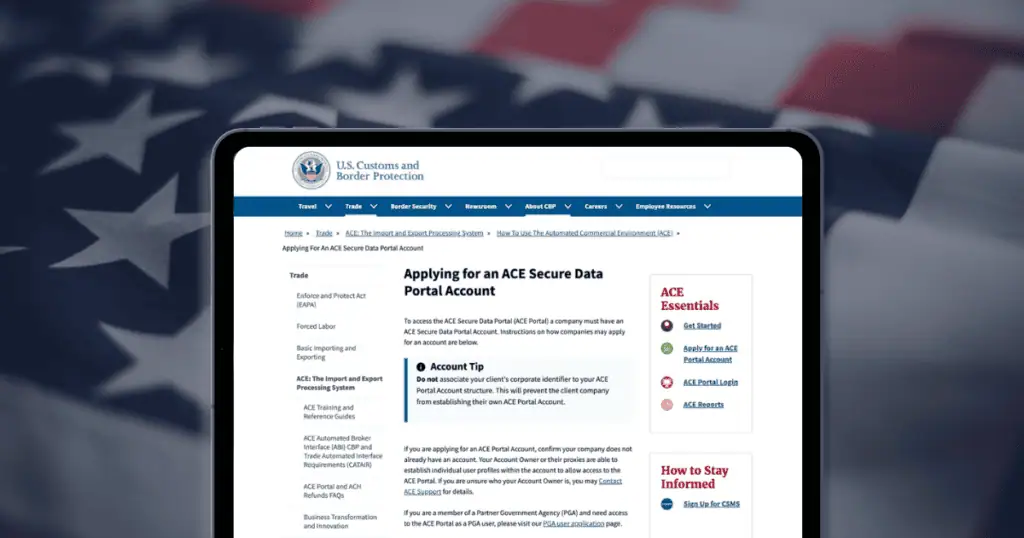
Detailed instructions are available here.
This includes:
- U.S.-based importers
- Non-resident importers
- Companies working with customs brokers
Even if a broker files entries on your behalf, an ACE account gives you direct visibility and control over your import data.
Follow these steps in order. In many cases your company already has an ACE account—so you may only need to be added as a user.
1. Start the application
Go to the ACE Portal application page and select Importer account.
2. Enter basic information
You’ll need:
- Company name
- Importer Record Number (EIN / SSN / CBP IR#)
- Business email address
3. System validation
CBP will automatically check:
- Your company matches the 5106 record
- Your email isn’t already tied to an ACE account
- Your importer record is eligible
4. Receive verification code
A verification code is sent to the Point of Contact (POC) email on your 5106 record
5. Enter verification code
- Code is valid for 10 minutes only
- Must be obtained from your internal POC or broker
6. Complete account details
You’ll enter:
- Company structure
- Address and contact info
- Account owner (TAO) details
7. Submit application
Once submitted:
- Your ACE account is created automatically
- You receive confirmation and login instructions
ACE Application Tips
- In Section 1, select “P” next to “Importer”
- Enter your full importer number including CBP-assigned suffix (EIN + Suffix, 12-345678900) in the first box
After you get access
- Confirm you can see your last 6–12 months of entries (or ask your broker which entry types your account should show).
- Pull an entry list and identify liquidation status for any entries you may need to correct or challenge.
- Pull the ES-003 Entry Summary Line Tariff Details ACE Report
If you import into the U.S. and don’t yet have ACE access, this is a high-impact task worth prioritizing. A properly configured account gives you immediate visibility into your customs activity and helps you respond faster when decisions or filings are time-sensitive.
Confirm your 5106 details, coordinate with your broker, and get your account established so you can operate with full data transparency.
After you get access
- Confirm you can see your last 6–12 months of entries (or ask your broker which entry types your account should show).
- Pull an entry list and identify liquidation status for any entries you may need to correct or challenge.
- Pull the ES-003 Entry Summary Line Tariff Details ACE Report
If you import into the U.S. and don’t yet have ACE access, this is a high-impact task worth prioritizing. A properly configured account gives you immediate visibility into your customs activity and helps you respond faster when decisions or filings are time-sensitive.
Confirm your 5106 details, coordinate with your broker, and get your account established so you can operate with full data transparency.
Reclaiming IEEPA Tariffs
When tariffs change or get overturned, the opportunity to recover duties can be real, but it’s rarely simple. Refunds aren’t automatic, and the process tends to be procedural, deadline-driven, and heavily dependent on the quality of your entry-level data. That’s exactly why ACE access matters. If you can pull your entry history, verify liquidation status, and isolate duty lines tied to specific programs, you’re in a much stronger position to understand whether a refund is even possible and what to do next.
If you think your business paid duties under IEEPA measures that were invalidated, Passport can help you evaluate eligibility and take action.
It walks through how to identify impacted entries, determine whether they’re liquidated or unliquidated, route each entry through the correct path (Post-Summary Correction vs. Protest), and build a clean internal tracker to preserve refund rights and reconcile any recovered duties. It’s designed for ecommerce importers of record who want a practical playbook, not a legal memo, so you can move quickly and confidently when timelines matter.
Official CBP references
- CBP: Applying for an ACE Secure Data Portal Account (cbp.gov → Trade → Automated Systems → Getting Started).
- CSMS # 68228015 – New ACE Portal Account Application Now Available
- CSMS # 66674007 – Enhanced ACE Portal Account Application Now Available – Ensure CBP Form 5106 Information Is Up-to-Date