


If you’re in ecommerce, you’re already thinking about AEO. The hype machine is real, but most teams are overcomplicating it. Today, AEO readiness is mostly a content architecture and data legibility problem, not a reason to replatform your storefront or buy another dashboard.
At Passport, we want to keep this practical.
In this article you’ll get:
- A brief intro to AEO (Agent Engine Optimization)
- A practical framework for what to do first
- Specific strategies to get your products recommended by AI search tools and LLMs
- A simple measurement loop you can run with 2 skill files
What is AEO (Agent Engine Optimization)?
AEO stands for Agent Engine Optimization (sometimes called GEO, Generative Engine Optimization, or AI search optimization). It’s the natural extension of SEO: instead of optimizing for ten blue links where the user picks one, you’re optimizing for a model that reads the web and returns a single synthesized answer.
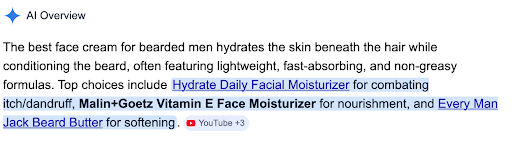
When a shopper asks Gemini:
“What’s the best face cream for bearded men?”
Or an operator asks:
“What’s the best cross-border shipping solution for Shopify brands?”
They don’t browse — they get an answer.
Your job is to be included in that answer.
How AEO is different from SEO (and why it matters for ecommerce)
For product and growth leaders, the job is no longer just ranking pages — it’s making your best answers easy for models to extract, trust, and cite.
Most of what you’ve built for SEO still helps: strong PDPs, relevant supporting content, and clear product explanations. But the rules shift in three important ways:
- The Consumption Model: AI agents bypass client-side analytics and read raw text, prioritizing machine-readability, token efficiency, and deterministic data. In ecommerce, that means clarity around pricing, fulfillment, and product details becomes critical for inclusion.
- The “Winner” Metric: AI synthesizes multiple sources. Being mentioned across five different citations beats ranking #1 in a single search result. Mention density across the web drives the AI’s “wisdom of the crowd,” especially for queries like “best international shipping solution” or “Shopify cross-border tools.”
- The Long Tail: Customers are asking longer, more specific conversational questions than traditional search engines were built to support. Queries like “best international shipping solution for DTC brands under 100K orders” are becoming the norm—not the exception.
What most ecommerce teams are getting wrong about AEO
Agentic commerce is still early, but the practical takeaway is simple: you do not need to rip out your commerce stack to prepare for it.
You might be seeing new shopping integrations in ChatGPT or Google and assuming AEO requires a platform migration, a new storefront, or a $99/month scoring dashboard. It doesn’t.
Agentic commerce readiness is currently a content architecture and data legibility problem, not a platform problem. You can optimize your existing content strategy for AEO without migrating platforms. LLMs rely on your existing web infrastructure, provided you serve them information in structured, deterministic formats.
⚠️ The real problem right now is paralysis, not overspending. Most ecommerce teams are stuck in one of two traps:
- Overthinking the work: treating AEO as a massive project, but missing the small, effective changes that can boost AI search visibility
- Underthinking the value: writing it off because AI-driven traffic is still small (~2% of most brands’ lead gen today), without realizing it’s low because it’s not optimized yet
The brands that move now, even modestly, will compound an advantage while everyone else is still debating whether to care.
A product leader’s framework for AEO: what to do first
For a product leader, the fastest path is usually:
- Establish a baseline: see which questions AI models already answer well about your category, brand, and competitors.
- Build off-site citation density: treat Reddit, video transcripts, affiliates, and PR as distribution channels — this is where most of the leverage actually comes from.
- Fix extractability on high-intent pages: tighten FAQs and help content so the best answer for an LLM is obvious in the first sentences.
- Add deterministic signals and rerun the audit: clean up schema, llms.txt, and robots.txt so models have less room to guess, then measure again.
A practical ownership split:
- Marketing / content: FAQ, help center, off-site content, PR, affiliate coverage
- Product / growth: prioritization, measurement, PDP structure, test design
- Engineering: schema markup, llms.txt, robots.txt, structured data hygiene
The 3 levers that actually move AEO (AI search visibility)
To win in the citation economy, you have to transition your product content from persuasive narrative to structured, extractable answers. Treat this as an operating loop, not a one-time content project. The three levers, ordered by impact:
Lever 1: Blanket the web with off-site citations (the “Reddit effect”)
This is the single highest-leverage move in AEO right now. Because LLMs synthesize answers based on consensus, mention density across trusted sources matters more than any single ranked page.
- Reddit is the kingmaker: LLMs heavily trust Reddit because the community aggressively polices spam. To increase citations on Reddit:
- Create authentic accounts
- Identify subreddits aligned with your product and customer
- Monitor and respond to relevant questions
- Provide genuinely helpful answers
💡 This doesn’t have to be a question about your product. The goal is to make your Reddit presence a credible, upvoted source for your category.
- Dominate “boring” video niches: YouTube transcripts are a massive citation source. Consumer content is saturated, but niche ecommerce and logistics topics are wide open. Create videos answering highly specific, long-tail questions about your product or category.
- Leverage affiliates & PR: Being cited by trusted publishers (like Dotdash Meredith) passes strong authority signals into AI-generated answers.

Lever 2: Architect content for extraction (BLUF & FAQs)
Once models have a reason to consider you, your own pages need to make it easy to cite you.
Your Help Center and FAQ pages are often the highest-leverage assets here.
- Adopt BLUF (Bottom Line Up Front): Lead every section with the direct answer in the first sentence. If content is truncated, the core message still gets captured.
- Keep answers atomic: 2–3 sentences, ~40–75 words. One direct answer + minimal context.
- Go hyper-specific: Most brands already use questions. The unlock is breaking broad questions into many narrow ones that match how users actually query AI tools.
- Use dedicated LLM-friendly FAQ pages (when needed): If this level of specificity bloats your main FAQ, create a separate page designed for AI readability and link to it clearly.
🔍 Turning your FAQ into specific questions (beauty brand example):
You probably already have a question like:
- “Are these products safe for sensitive skin?”
The AEO-friendly version breaks it into the exact queries shoppers actually type into ChatGPT:
- “Are {{brand}} products safe for oily skin?”
- “Are {{brand}} products safe for dry or dehydrated skin?”
- “Are {{brand}} products safe for combination skin?”
- “Are {{brand}} products safe for rosacea?”
- “Are {{brand}} products safe during pregnancy and nursing?”
- “Are {{brand}} products safe for fragrance sensitivity?”
If that level of granularity would bloat your customer-facing FAQ, put it on a separate LLM-targeted page and point crawlers to it via llms.txt.
Lever 3: Implement deterministic, machine-readable signals
LLMs are probabilistic prediction engines. Deterministic signals reduce guesswork.
- Deploy structured schema: Use FAQPage, HowTo, and product schema where relevant. Clearly define pricing, availability, and product attributes.
- Consider an llms.txt file: Think of this as a structured index for AI tools. It can help guide models to your most relevant content (especially FAQ and documentation pages).
- Audit your robots.txt: Make sure you’re not unintentionally blocking AI crawlers from important pages.
Get started with AEO today
ou don’t need to wait or hire a consultant to get started. The first job is to set a baseline, improve the assets that matter most, and then measure again.
Here’s the operating loop:
- Generate the question set: pull real buyer questions from Reddit, Quora, and niche forums.
- Run the audit: test those questions across ChatGPT, Claude, and Gemini to see when your brand is recommended, ignored, or outcompeted.
- Improve the assets: update FAQs, help content, PDP structure, and machine-readable signals based on the gaps.
- Rerun the audit: track whether recommendation rate, competitor overlap, and coverage improve over time.
There are services charging $100s per year to do this for you, but Passport is going to let you run the first version yourself using two skills
{{file link here}} is a question generator. It looks through real sources on Reddit, Quora, and niche forums to find where your company has been mentioned and generates a list of buyer questions to load into LLMs to see if they recommend your product.
{{file link here}} is an auditor. It takes the results of your first file and audits against ChatGPT, Claude, and Gemini, then provides you with raw data on the percentage of time your product was recommended, a summary of where you did better or worse, and which competitors showed up in the answer engines.
✍️ Required edit: choose the CTA you actually want to ship here. If the goal is LinkedIn engagement, this is the place to replace the placeholder with something like “Comment ‘skills’ and I’ll send the files,” or swap in the Passport link if you want a click-through CTA instead.
Don’t become invisible in AI search
AEO may still be early, but most ecommerce teams are making it harder than it needs to be.
Before you buy another dashboard or start talking about replatforming, make sure your content is actually easy for models to read, extract, and cite.
The brands that win first will usually be the ones with the clearest answers—not the fanciest tooling.
How Passport helps
At Passport, we help ecommerce brands grow globally—through better localization, cross-border logistics, and conversion-ready international experiences.
As AI changes how brands are discovered, the fundamentals don’t change clarity, structure, and relevance.
If your ecommerce experience is easy for customers to understand, it should also be easy for AI systems to understand.
Want the skills that will let you automate this with Claude Code or OpenClaw? Email marketing@passportglobal.com to get the zip files containing them from Passport today.
Or, if you’re thinking about how to scale internationally, talk to a Passport expert. Our team combines hands-on global growth expertise with AI-driven solutions to help you expand faster, reduce complexity, and convert more customers worldwide.

Authored by Ilan Rotenberg
Senior Director, Product | Passport
Ilan Rotenberg, a seasoned engineering and product pro, boasts six years in software product management. Fueled by a passion for elevating user experience, Ilan excels in unraveling user problems, fostering product adoption, and streamlining customer flows. Armed with a Master’s in Mechanical Engineering from the University of British Columbia, Ilan has left an indelible mark, co-creating products with clients such as Airbus, the United Nations, Toyota, Rhode Beauty, and Clove.