


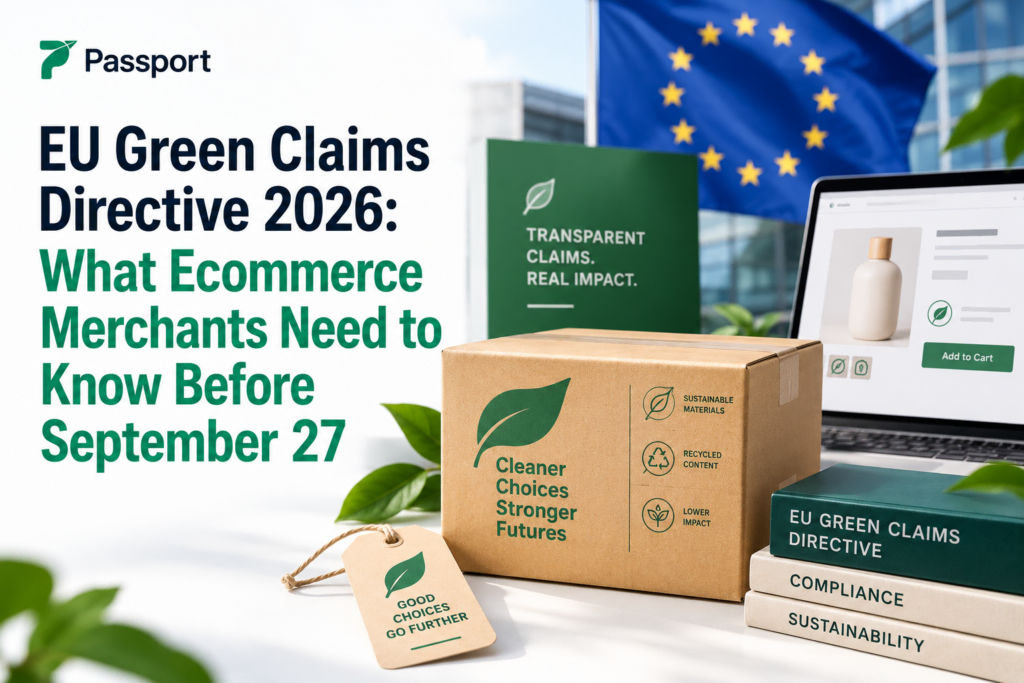
The EU’s latest consumer goods directive requires merchants selling to EU consumers to take three specific actions before September 27, 2026:
- Add the EU’s official legal guarantee notice to your storefront and attach it to order confirmation emails. This notice reminds shoppers that goods carry a minimum two-year guarantee if defective.
- Drop any vague environmental claims (e.g., “eco-friendly,” “green,” “carbon neutral”) you can’t back with documented evidence.
- Add a GARAN label if you offer a free guarantee covering an entire product for more than two years.
Both the legal guarantee notice and the GARAN label use official European Commission artwork that can’t be redesigned. You can download the notice and GARAN files here.
Because these changes live on your own storefront and emails, Passport can’t apply or configure them for you.
The EU’s latest consumer goods directive shifts focus from duties and customs declarations to a different area of compliance: how brands talk about sustainability, and what they owe shoppers in terms of guarantee information.
***
From September 27, 2026, Directive (EU) 2024/825 — officially called “Empowering Consumers for the Green Transition,” or EmpCo — takes effect in the 27 EU member states.
EmpCo does two distinct things, and merchants need to treat them separately:
- Cracks down on greenwashing — banning a defined list of vague or unsubstantiated environmental marketing claims.
- Harmonises guarantee information — requiring a harmonised legal-guarantee notice on every storefront, and a GARAN durability label for qualifying products.
Both apply to any trader selling goods to consumers in scope, regardless of where the business is based or headquartered — the test is whether commercial activity is directed at those consumers, not where the seller is established.
Part 1: The greenwashing crackdown
Merchants should review environmental or sustainability claims across their storefront, ads, emails, and packaging — and be ready to substantiate or remove them.
Avoid these unless they can be substantiated with reliable, specific evidence:
- Vague claims like “eco-friendly,” “green,” “sustainable,” or “carbon neutral”
- Sustainability badges or labels that aren’t tied to a recognized certification scheme or public authority
- Claims of reduced environmental impact based solely on carbon offsetting
- Framing legal compliance or standard product features as special environmental benefits
Where claims do hold up, merchants should:
- Make sure they’re accurate, specific, and evidence-backed
- Maintain supporting documentation — certifications, methodologies, test data — in case of a challenge
- Review claims everywhere they appear: product descriptions, images, labels, ads, emails, and checkout content
Deadline: Merchants should complete a review of environmental claims and supporting evidence across their storefronts and marketing materials before September 27, 2026.
Tools to help
We’re not specifically recommending these services, but they may be useful starting points:
- EU Green Claims & EmpCo Check (Shopify App Store) — scans a storefront for risky claims ahead of the deadline.
- EcoClaim — a free, no-signup scanner that checks Shopify, WooCommerce, or Wix stores against a list of banned terms and the EmpCo/ECGT Directive, per the vendor’s listing.
Part 2: The legal-guarantee notice and the GARAN label
The second half of EmpCo is about disclosure. It requires two pieces of standardized information, with the official artwork and formats published under Implementing Regulation (EU) 2025/1960:
The harmonised legal-guarantee notice
This is an official notice, designed by the European Commission, reminding shoppers that goods bought in the EU carry a minimum two-year legal guarantee of conformity if they turn out to be defective. This isn’t a new right — it’s an existing consumer protection. EmpCo just requires it to be disclosed clearly, using the Commission’s unaltered artwork, in two places:
- On the storefront, as a prominent, general reminder — a dedicated info section, footer link, or banner. Checkout display is not required — this is a general site-wide disclosure, not a step in the purchase flow — and it needs to be readable on both desktop and mobile.
- In the order confirmation email, on a “durable medium” rather than just a link (for example, an attached PDF).
Relevance is determined by the shopper’s delivery address, not the merchant’s location — an order shipping to an EU address triggers the requirement even if the merchant is based elsewhere.
The GARAN label
A separate label required only where a producer offers a free commercial guarantee of durability covering the entire product for more than two years — and has communicated that guarantee to the merchant, who is then responsible for displaying it to shoppers.
All conditions have to be met; it’s not required by default. In practice, GARAN is more likely to come up for long-life or higher-value products (watches, appliances) and less likely for categories like apparel.
Where it does apply, the GARAN label needs to appear:
- On the website before purchase — Checkout is treated as an illustrative option only, not a requirement — the label doesn’t need to be built into the checkout flow.A best practice is to include this as an image in the product carousel.
- In the confirmation email, alongside the legal-guarantee notice, when the order includes a qualifying product. Again, this needs to be attached, not just hyperlinked.
Both the notice and the GARAN label use official Commission artwork that can’t be redesigned. For GARAN, only three fields may be changed: guarantee duration, brand/producer, and model — everything else, including the multilingual strip along the bottom, stays as issued.
Shopify apps
There are several Shopify apps like Lowlands GARAN Guarantee Label that display the harmonised notice and GARAN labels in all 24 EU languages, per the app listing, with a free plan available for the notice and tiered plans for GARAN label volume
How Passport Can Help
For brands using Passport Seller of Record (SOR), no action is needed on the tax/compliance side we manage — this directive doesn’t change VAT or duty handling. But because these are storefront- and marketing-facing obligations, brands remain responsible for their own environmental claims, on-site notice placement, and GARAN labeling where applicable.
Where Passport acts as Merchant of Record (MOR) for in-country sales, we’ll make the necessary updates on our side. (If you’re unsure which arrangement applies to your account, your account team can confirm.)
The bottom line
Two different deadlines, two different teams:
- Marketing and brand teams should be auditing environmental claims now — vague or unsubstantiated language needs to come down before September 27.
- Ecommerce/ops teams should confirm the harmonised guarantee notice is live on-site, and — for any products with a genuine multi-year durability guarantee — that GARAN labels are in place before purchase.

Authored by Thomas Taggart
Head of Global Trade | Passport
Thomas Taggart is a cross-border commerce leader with more than 20 years of experience in international shipping and regulatory affairs. As the Head of Global Trade, Thomas helps ecommerce brands go global by simplifying international trade, tax, and product compliance issues. Prior to Passport, he brought international shipping solutions to market through multiple roles in UPS’s product development organization.
Frequently Asked Questions
What is EmpCo?
EmpCo is the informal name for Directive (EU) 2024/825, “Empowering Consumers for the Green Transition.” It’s an amending directive — it doesn’t stand alone, but rewrites parts of the Unfair Commercial Practices Directive and the Consumer Rights Directive to add new rules on environmental marketing claims and guarantee disclosures.
When does it take effect?
September 27, 2026, in the 27 EU member states. It’s EEA-relevant and expected to extend to Norway, Iceland, and Liechtenstein, but as of this writing it hasn’t been incorporated into the EEA Agreement, so no firm date exists yet for those three markets.
Does this apply to Norway, Iceland, and Liechtenstein?
Not yet, on a confirmed basis. The directive is EEA-relevant, so it’s expected to extend to the three EEA/EFTA states as well, but as of this writing it has not been incorporated into the EEA Agreement, and no firm effective date exists for those three markets. Merchants selling there should treat EU-27 compliance as the template to follow, but shouldn’t assume the September 27, 2026 deadline applies yet.
Does this apply to merchants based outside the EU?
Yes. The test is whether commercial activity is directed at consumers in scope, not where the seller is established or headquartered. A US-based brand shipping to EU shoppers is in scope; relevance is determined by the shopper’s delivery address.
What environmental claims are banned outright?
Vague, unsubstantiated claims like “eco-friendly,” “green,” “sustainable,” or “carbon neutral” without evidence; sustainability badges not tied to a recognized certification scheme; claims of reduced impact based only on carbon offsetting; and framing ordinary product features or legal compliance as special environmental benefits.
Does this mean we can never make an environmental claim?
No. Claims are allowed if they’re accurate, specific, and backed by reliable, documented evidence — certifications, methodologies, or test data merchants can produce if challenged. The directive targets vague or unsubstantiated claims, not substantiated ones.
What is the harmonised legal-guarantee notice?
An official notice, designed by the European Commission, reminding shoppers that goods bought in the EU carry a minimum two-year legal guarantee of conformity if they turn out to be defective. This right already exists under EU consumer law — EmpCo just requires it to be disclosed clearly and consistently, using official Commission artwork.
Where should the legal-guarantee notice appear?
Sellers should display the official harmonised notice prominently on their online storefront as a general reminder — for example, through a visible header, footer, catalogue, or dedicated legal-guarantee page. This isn’t required at checkout as a separate step. The notice should then be confirmed in the order confirmation on a durable medium, such as the email itself or an attached document. The official English-language artwork is used across all EU markets and must not be materially redesigned.
Is the notice or GARAN label required at checkout?
No. Both are required on the storefront (general placement for the notice; the product page for GARAN) and in the confirmation email — checkout display is not required for either, per Global-e’s published guidance and the underlying Implementing Regulation.
Where do the notice and GARAN label need to appear?
The harmonised notice needs a prominent, general placement on the storefront (a footer link, banner, or dedicated info page) and in the order confirmation email on a durable medium, such as an attached PDF. The GARAN label, where applicable, needs to appear on the product page before purchase and in the confirmation email alongside the notice. Neither is required at checkout.
Can we redesign the notice or GARAN artwork to match our brand?
No. Both use official Commission artwork under Implementing Regulation (EU) 2025/1960 that can’t be altered. For GARAN, only three fields may be changed — guarantee duration, brand/producer, and model. Everything else, including the multilingual strip, must stay as issued.
Does Passport handle this as part of SOR or MOR?
Passport’s Seller of Record service isn’t affected — this directive doesn’t touch VAT or duty handling. It’s a storefront and marketing disclosure requirement, so brands remain responsible for their own claims, notice placement, and GARAN labeling. Where Passport acts as Merchant of Record for in-country sales, we’ll make the necessary updates on our side.
What should we do before September 27, 2026?
Marketing/brand teams should audit environmental claims across product pages, ads, emails, and packaging, and remove or substantiate anything vague. Ecommerce/ops teams should confirm the harmonised guarantee notice is live on-site and, for any products with a genuine multi-year durability guarantee, that GARAN labels are in place on the product page and in confirmation emails before purchase.
Sources & Regulatory References
- EUR-Lex — Directive (EU) 2024/825
- EUR-Lex — Implementing Regulation (EU) 2025/1960
- EU Legal Guarantee – Country-Specific Rules
- EU Legal Guarantee – Example
- EU GARAN Product Label – Commercial guarantee of durability example
- EU Commission – Empowering the consumer for the green transition
- Global-e — EU Consumer Guarantee Notice and GARAN documentation
- Shopify App Store — EU Green Claims & EmpCo Check
- Shopify App Store — Lowlands GARAN Guarantee Label
- EcoClaim — Free EU EmpCo / ECGT Greenwashing Scanner