




If you import goods into the U.S. and later export or destroy them, you could be eligible to recover up to 99% of the duties and fees you paid at import. That’s the power of duty drawback—a long-standing U.S. Customs program that’s becoming newly relevant as brands face higher tariffs, tighter margins, and rising cross-border costs.
With multiple tariff layers now in play—Section 301 tariffs from China, new reciprocal tariffs, and fees like MPF and HMF—drawback can translate directly into better cash flow. Yet billions of dollars in eligible refunds go unclaimed each year.
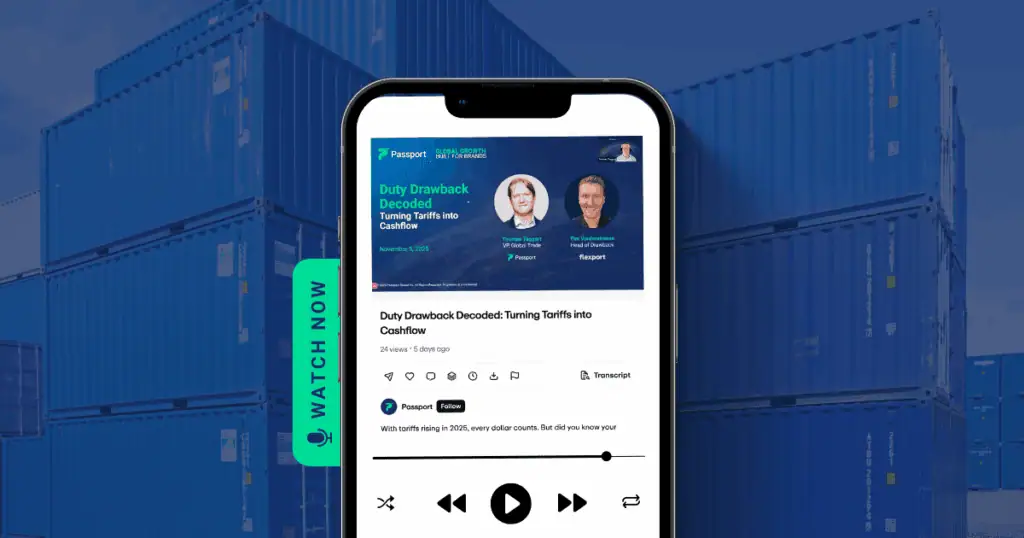
That’s why Passport teamed up with Flexport to unpack how drawback works, what qualifies, and how ecommerce brands can actually take advantage of it.
🎙️ Speakers:
Thomas Taggart — VP of Global Trade, Passport
Tim Vorderstrasse — Head of Drawback, Flexport
Key takeaways
- Drawback is an export program, not a tax refund. It’s about recovering import duties once those goods are exported or destroyed.
- Plenty qualifies. Standard duties, Section 301 (China) tariffs, the Merchandise Processing Fee (MPF), and the Harbor Maintenance Fee (HMF) are commonly recoverable.
- Some charges are off-limits. Section 232 (steel/aluminum), anti-dumping and countervailing duties (AD/CVD), and the recent “fentanyl” tariffs are not eligible.
- Returns can complicate claims. Domestic retail returns count as “used” goods, so they can disqualify shipments unless handled carefully.
- Start early and plan for time. Drawback requires privileges from U.S. Customs and Border Protection (CBP) before you can receive claims payments. Once approved, accelerated payment can shorten your refund timeline to 4–6 weeks.
What duty drawback actually is (and isn’t)
Duty drawback isn’t new—it’s been part of U.S. law since 1789. The goal: encourage exports by refunding import duties when the imported goods, or products made from them, are later exported or destroyed.
A simple example:
If you import a $100 pair of sneakers from Vietnam and pay a 10% duty ($10), and later export that same pair to a customer in Canada, drawback allows you to claim back roughly $9.90 of that $10.
What it’s not:
- It’s not a refund for misclassified imports (those are fixed with a post-summary correction or protest).
- It’s not a generic “returns refund.” Only specific export or destruction scenarios qualify.
What’s usually eligible—and what’s not
Often eligible for recovery:
- Base duties – Standard tariff rates tied to your HTS code and country of origin.
- Section 301 tariffs – The additional 25% on many Chinese-origin goods since 2018.
- Merchandise Processing Fee (MPF) – Charged on formal entries; currently capped at $651 per entry.
- Harbor Maintenance Fee (HMF) – Assessed on ocean shipments; small per-entry rate that adds up.
- Reciprocal tariffs – 2025’s new IEEPA tariffs
Commonly ineligible:
- Section 232 steel/aluminum tariffs.
- Anti-dumping / Countervailing duties (AD/CVD).
- “Fentanyl” tariffs (recent 10–20% surcharge on Chinese goods).
- Exports to Canada, Mexico, or Chile under substitution drawback (you can still use direct identification there).
Pro tip: Make sure your HTS codes are correct and consistent on both import and export declarations. That classification drives eligibility and substitution matching.
Types of duty drawback most common for ecommerce
1. Unused merchandise
This is the bread and butter of ecommerce drawback. You import finished goods, sell and ship them overseas in the same condition, and claim the refund.
There are two ways to match those shipments:
- Substitution drawback: Match imports and exports by HTS code, not at the specific SKU level. That’s how most apparel, footwear, and consumer brands maximize recovery outside North America.
- Direct identification: Tie each export back to the specific import using identifiers (lot, PO, or carton number) or an approved accounting method (like FIFO or LIFO).
2. Rejected merchandise (returns)
Returns are one of the biggest pitfalls for ecommerce brands. From Customs’ perspective, even trying on a shirt counts as “use.” Once used, it no longer qualifies as “unused merchandise.”
If you mix domestic returns back into your export inventory, you can lose drawback eligibility across that pool.
Best practices to protect your program:
- Separate locations: Keep returned goods in a distinct storage bin or pick zone used only for domestic orders.
- Label clearly: Add colored stickers or different polybags to identify returns visually.
- Tag electronically: Assign a separate SKU suffix, RFID flag, or return prefix in your system.
- Redirect returns: Send them to retail stores instead of export fulfillment centers.
These small steps preserve the integrity of your export pool and keep you compliant.
3. Manufacturing drawback
For brands that import components or packaging—like cosmetics, supplements, or electronics—and manufacture in the U.S., drawback applies when those finished goods are exported.
Example: you import lip gloss containers, fill them in the U.S., and export the final product. The imported containers and raw materials can qualify for drawback under the manufacturing provision.
It takes more documentation (like a Bill of Materials) and a formal ruling from CBP, but it can be one of the most valuable routes for complex brands.
How brands qualify and claim drawback
Even without serial numbers or lot tracking, CBP allows approved accounting methods for matching imports and exports:
- FIFO (First In, First Out) – Pairs the oldest imports with the earliest exports.
- LIFO (Last In, First Out) – Matches the newest imports first.
- Low-to-High – Simpler but less favorable; matches lowest-duty imports first.
- Low-to-High with average inventory turnover – A middle ground that limits the lookback window.
If you’re using a blanket low-to-high method today, both experts suggest reviewing it—today’s tariff volatility makes FIFO or LIFO much more efficient.
Building a drawback program: what to expect
Setting up drawback isn’t instant—and it must be managed by a licensed drawback provider who handles filings, data coordination, and CBP communication on your behalf.
Typical timeline:
- 1–3 months – Prepare documents, align import/export data, and file your privilege application.
- 4–9 months – Wait for CBP to grant privileges and submit your first claim. You can collect and clean data during this period and prepare claims.
- 4–6 weeks (after approval) – Receive refunds via Accelerated Payment if you’ve applied with a bond.
Step-by-step:
- Apply for privileges — Include all applicable provisions (unused, rejected, manufacturing, packaging) and accelerated payments.
- Collect import/export data — Your drawback provider will pull import entries from ACE or your broker, export data from your ERP, 3PL, or carrier, and format it for claims submission.
- Start small. Your first claim gets a desk review, where CBP typically selects 5–7 transactions to audit. A smaller test claim helps validate your program before scaling.
Without Accelerated Payment: refunds can take 18–24+ months, since CBP waits for all related imports to fully “liquidate.”
Estimating your opportunity
You can estimate potential recovery in two quick ways:
- Top-down: (Duties + fees paid on imports) × (% of those goods exported) × 99%.
- Bottom-up: (Export value) × (duty rate) × 99%.
Reality depends on your product mix, tariff exposure, and data quality. But Tim noted that early estimates usually land within ±30% once real data is run.
Is it worth it?
If your potential annual recovery is under $30,000–$50,000, it might not justify the effort—unless your data is exceptionally clean. But brands recovering six figures or more see a clear ROI.
For brands that ship with Passport, the threshold can be lower. Because we act as the carrier, Passport can streamline the process and make duty drawback accessible even for smaller recovery amounts.
“Over the past two years, Passport has helped us recover huge savings through Duty Drawback. Not only that, they significantly improved our cash flow through a unique drawback solution so we didn’t have to wait a year to receive our claim.”
– Austin Jang, VP of Operations
Common pitfalls (and how to avoid them)
- Commingled returns: Separate or mark them immediately.
- Inconsistent HTS codes: Standardize before you start claims.
- Missing export proof: Carriers recycle tracking numbers—save PDFs of shipping labels and PODs early.
- Oversized first claim: Start small to pass the initial desk review smoothly.
Who does what: brand, broker, and provider
- Your customs broker files import entries and holds records.
- Your 3PL holds fulfillment and sometimes import/export data.
- Your carrier holds the export and proof of delivery records
- Your drawback provider connects the dots—matching import, inventory, and export data, submitting the claim, and managing communications with CBP.
A strong provider handles the heavy lifting—ensuring your accounting methods, data hygiene, and bond setup all align.
Smart questions to ask a provider
- Which drawback provisions fit our products and data?
- How do you connect broker entries to 3PL data?
- Can you handle substitution globally and Direct ID for Canada, Mexico, and Chile?
- How do you support the full desk review audit?
- Will you manage Accelerated Payment, bonds, waivers, and escalations?
- What’s your minimum annual refund threshold, and how do fees scale?
Q&A from the session
- “If I used the wrong HS code, can drawback fix it?”
No. You’ll need a post-summary correction (before liquidation) or a protest (within 180 days) to correct it. - “Do international returns qualify?”
Generally yes, if the item was exported and returned in the same condition. The issue is with domestic returns—those are considered “used” and can disqualify the export pool.
Getting started with duty drawback
Duty drawback can be one of the most underused cash-flow tools for ecommerce brands. If you import and export—even occasionally—it’s worth understanding how the program works and whether you qualify.
The setup takes coordination, but once your privileges are in place, the payoff can be substantial.
Passport’s trade experts can help you estimate your potential recovery, connect you with licensed providers, and prepare the right documentation—so you have everything you need to grow profitably.
Ready to explore your potential recovery? Email us at drawback@passportglobal.com or request a demo.