



If you sell internationally, import customs duties and taxes are one of those things you can’t ignore but many ecommerce brands still don’t fully understand them.
The result? Unexpected costs, frustrated customers, and abandoned carts.
This guide breaks it down simply: what import duties and taxes are, how they’re calculated, who pays them and most importantly how to manage them strategically.
Import Customs Duties and Taxes Explained: Meaning, Types, and Key Differences
Before getting into calculations and strategy, it’s important to clearly understand what people mean when they talk about customs duties, taxes on imported goods, and import fees.
Import customs duties are charges applied by a country’s customs authority on goods entering from abroad. These duties are primarily determined by the type of product being shipped. In other words, they depend on how the product is classified — its category, materials, and intended use. For example, apparel, electronics, and cosmetics can all have very different duty rates.
Alongside duties, there are often taxes on imported goods, such as VAT (Value-Added Tax) or GST (Goods and Services Tax). Unlike duties, these taxes are not usually based on the product category itself, but on the total value of the shipment. In many countries, that includes the cost of the product, shipping fees, and even the duties.
Finally, there are additional import fees charged by carriers or customs intermediaries. These can include brokerage, clearance, and handling fees required to process the shipment through customs.
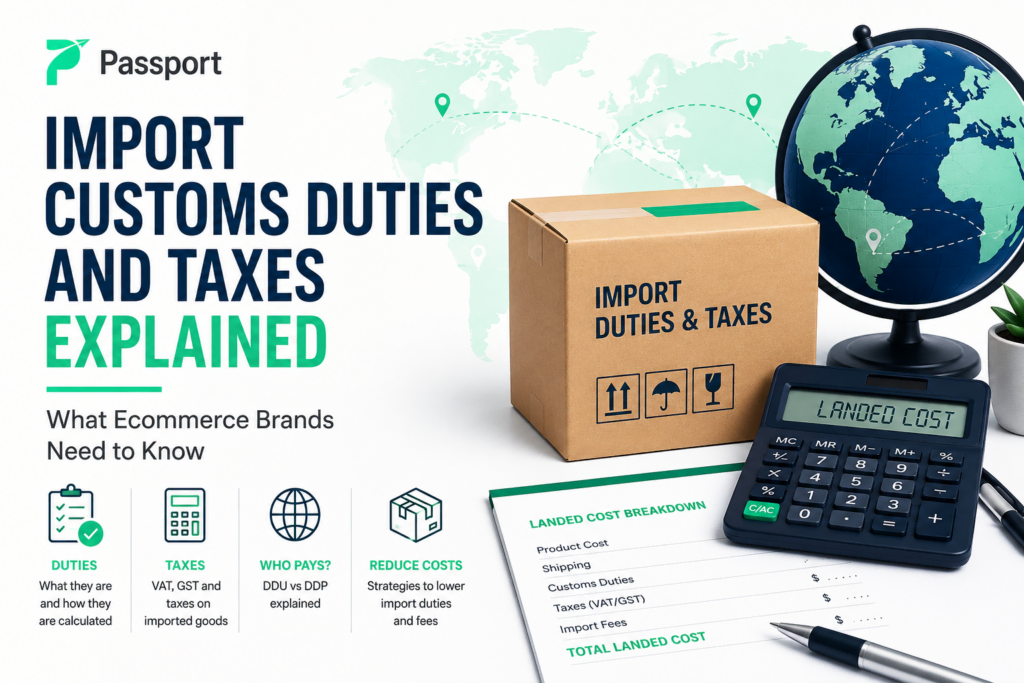
When combined, all of these costs — duties, taxes, and fees — make up the total import cost, often referred to as the landed cost. This is the full amount that must be paid for a product to successfully clear customs and reach the customer.
How Are Import Duties Calculated?
The first and arguably most important is the Harmonized System (HS) code. Every product that crosses a border is assigned an HS code, which acts as a universal classification system. This code tells customs what the product is, and from that, they determine the applicable duty rate. Even small differences in classification can lead to different rates, which is why accuracy here really matters.
The second factor is customs valuation, or the value assigned to the goods being imported. In most cases, this is based on the transaction value—the price the customer paid for the product. However, depending on the country and the type of order, this value may also include additional costs like shipping and insurance.
The third key element is the country of origin, meaning where the product was manufactured (not where it was shipped from). This matters because trade agreements between countries can reduce or eliminate duties altogether. On the flip side, targeted tariffs—whether retaliatory, antidumping, or policy-driven—can dramatically increase duty rates for specific origins. For example, recent shifts in U.S. trade policy and tariff rulings have had major implications for import costs. You can explore ongoing updates in our IEEPA tariffs guide for importers, or track real-time changes using tools like Trump Trade Tracker.
When you put these together, you can look at landed cost this way:
- The HS code determines the rate
- The customs value determines the amount the rate is applied to
- The country of origin determines whether that rate is reduced, increased, or unchanged
While the underlying system is standardized globally, each country applies its own rules and thresholds, this is why duty calculations can vary from one market to another.
In simple terms: Duties + Taxes + Fees = Total landed cost
Who Pays Import Duties and Taxes?
When it comes to customs duties and taxes, one of the biggest decisions ecommerce brands face is: who pays?
There are two main models.
In a DDU (Delivered Duties Unpaid) model, the customer is responsible for paying all customs charges, including duties, taxes, and import fees, when the shipment arrives. While this reduces upfront costs for the merchant, it often creates a poor experience.
Typically, the customer is contacted by a local broker or carrier and asked to pay before delivery. This unexpected request, often referred to as a “surprise fee”, is one of the biggest reasons international orders fail. Many customers refuse to pay, leading to returns, delays, and lost revenue.
In fact, in today’s ecommerce landscape, customs processes, duties, and regulatory compliance are among the biggest challenges in cross-border ecommerce, often leading to delays and delivery issues.
In contrast, the DDP (Delivered Duties Paid) model shifts responsibility to the merchant. Here, duties and taxes are calculated upfront and collected at checkout. Some brands even use a landed cost calculator to ensure accuracy in real time.
The result is a seamless, “domestic-like” experience for customers with no surprises, no delays, and no additional payments at delivery. This is why most modern ecommerce brands are moving toward DDP because it improves transparency and reduces friction.
If you want a deeper breakdown, see our full guide on DDP vs DDU for ecommerce brands.
Fees Beyond Duties and Taxes
When calculating the true cost of shipping internationally, many ecommerce brands focus only on duties and taxes even though that’s only part of the picture. There is another layer to consider: additional import fees. These costs are often less visible, yet they can add up quickly and significantly impact both your margins and your customer experience.
Most of these fees come from the logistics and customs clearance process itself. For instance, customs brokerage fees are charged by the party responsible for clearing the goods through customs, often the carrier (like DHL or FedEx) or a specialized third-party broker.
In addition, carriers may apply clearance or administrative fees for processing shipments as they move through customs. These charges can vary depending on the destination country, shipment value, and complexity of the clearance process.
There are also handling or processing fees, which cover the physical inspection, storage, or movement of goods within customs facilities. While each of these charges may seem minor on its own, together they form an important part of the total cost of importing goods.
The challenge for ecommerce brands is that these additional import fees are not always clearly communicated upfront. As a result, they often appear as unexpected charges at delivery. This lack of transparency can lead to frustrated customers, refused packages, and ultimately a poor buying experience.
For brands managing global tax compliance, working with a seller of record solution can simplify how duties and taxes are handled across markets
How Ecommerce Brands Can Reduce Import Costs
You can’t eliminate import duties and taxes entirely since those are set by governments but you can take steps to reduce how much you pay and avoid unnecessary costs.
One of the most important factors is product classification. Every item you ship internationally is assigned a Harmonized System (HS) code, which determines the duty rate. If a product is misclassified, even unintentionally, you could end up paying a higher duty than necessary. Ensuring your products are mapped to the correct HS codes is one of the simplest ways to avoid overpaying.
Another opportunity lies in trade agreements between countries. Depending on where your products are manufactured, where they are shipping from, and where they’re being shipped, you may qualify for reduced or even zero-duty rates. These agreements can significantly lower costs, but only if you have the proper documentation and correctly declare the country of origin.
Your fulfillment strategy also plays a major role. Shipping every order across borders from a single location can quickly become expensive. Many brands reduce import costs by storing inventory closer to their customers using regional warehouses or third-party logistics providers. By fulfilling orders domestically (or within a trade zone), you can often avoid import duties altogether on individual shipments.
Finally, there’s the concept of de minimis thresholds: the minimum value below which customs duties and taxes may not apply in certain countries. Historically, ecommerce brands have used these thresholds to reduce costs by keeping shipments below the limit. However, this strategy is becoming less reliable since major markets are tightening regulations:
- The U.S. has eliminated its de minimis advantage for cross-border flows, increasing exposure to customs duties and taxes
- The EU is removing its €150 duty exemption, expanding the scope of tax on imported goods
- Globally, governments are increasing enforcement on low-value imports and import fees
This reflects a broader trend: more shipments are now subject to full customs charges, regardless of value.
Taken together, these strategies don’t just reduce costs but they make your cross-border operations more efficient and predictable. For ecommerce brands, that’s the real advantage: fewer surprises, better margins, and a smoother experience for customers.
How to Improve Pricing Transparency
In cross-border ecommerce, pricing transparency isn’t just a nice-to-have, it’s a competitive advantage. When customers shop internationally, they’re already navigating longer shipping times and unfamiliar brands. The last thing they want is uncertainty around the final cost of their purchase.
One of the most effective ways to build trust is by showing duties and taxes at checkout, rather than leaving them as an unknown. When customers can see the full cost upfront, they’re far more confident completing their purchase.
Many brands take this a step further by offering all-inclusive pricing through a DDP (Delivered Duties Paid) model. In this setup, everything—product cost, shipping, duties, and taxes—is bundled into a single, clear price. From the customer’s perspective, it feels no different than ordering domestically.
Clear communication also plays a key role. Your shipping and returns policies should explicitly explain whether duties and taxes are included, and what customers can expect at delivery. Even if you’re not yet offering DDP, being upfront about potential charges is far better than leaving customers in the dark.
What brands should avoid at all costs is the “surprise fee” experience. Unexpected charges at delivery are one of the fastest ways to lose customer trust and damage your brand reputation.
Ultimately, customers are much more likely to convert and come back when they know exactly what they’re paying from the start.
For brands managing returns, it’s also important to understand how to recover costs especially since duties and taxes may be reclaimable. Learn more in our guide to recovering duties and taxes on international returns.
How Passport Can Help
Passport’s easy-to-integrate software enables brands to accurately calculate and collect customs duties and taxes, import fees, and total landed cost at checkout. This allows you to present customers with a clear, upfront breakdown of costs, eliminating surprise customs charges and improving the overall buying experience.
With Passport, brands can:
- Display fully landed cost at checkout, including duties and taxes
- Ensure accurate, real-time import duty calculations
- Reduce the risk of customs delays and unexpected import fees
- Maintain control over pricing, margins, and customer experience
For brands looking to go further, Passport Global™ offers an all-in-one internationalization solution. This includes localization, compliance support, and growth advisory services, helping you navigate tax on imported goods, optimize cross-border strategy, and scale into new markets with confidence.
If you’re ready to simplify customs duties and taxes and create a seamless international shopping experience, Passport can help you get there.
Reach out to our team to get started.

Authored by Thomas Taggart
Head of Global Trade | Passport
Thomas Taggart is a cross-border commerce leader with more than 20 years of experience in international shipping and regulatory affairs. As the Head of Global Trade, Thomas helps ecommerce brands go global by simplifying international trade, tax, and product compliance issues. Prior to Passport, he brought international shipping solutions to market through multiple roles in UPS’s product development organization.
Frequently Asked Questions
What are import customs duties?
Import customs duties are charges applied to goods entering a country, based on classification and value.
What are customs duties and taxes?
Customs duties and taxes include duties based on product type and taxes on imported goods like VAT or GST.
How do you calculate customs duty on imports?
Customs duty is calculated using the product’s HS code, customs value, and country of origin. The HS code determines the rate, while the value and origin determine how much is owed.
What are customs charges?
Customs charges include duties, taxes, and additional import fees like brokerage and handling.
What are import fees?
Import fees are extra costs beyond duties and taxes, including clearance and processing charges.
Who pays duties and taxes?
Depending on the model (DDU or DDP), either the customer or the merchant pays customs duties and taxes.
Is customs duty the same as import tax?
No. Customs duty is based on the product type, while import taxes (like VAT or GST) are based on the total shipment value.