

Tapping into foreign markets is a great way to power growth, but how you ship is just as important as where you sell. Compare and contrast your two main options for international order fulfillment: cross-border and in-country.
For most ecommerce brands, the real decision is not whether to sell internationally, but where and how. The way you deliver orders shapes everything from margins to market access and the customer experience.
Expanding internationally creates new revenue opportunities, but comes with a critical decision: how to best fulfill orders in each market.
To that end, there are two strategies in the ecommerce entrepreneur’s toolkit: cross-border shipping and in-country fulfillment. In other words, do you continue shipping international orders from your home warehouse, or store some inventory on foreign soil and ship it locally from there?
Simply put, this distinction may sound unimportant, but the implications for your business are consequential to your international reach.
Read on to learn how they both work and which is more appropriate for your current stage of growth.
What Is Cross-Border Ecommerce?
Cross-border ecommerce refers to international sales fulfilled from your domestic warehouse. You keep all your inventory within the main country of operation while serving foreign markets.
Example: A cosmetics brand based in California stores all its products in-state, where orders are dispatched across the U.S., Canada, and the U.K..
Brands engaging in cross-border ecommerce typically use a centralized inventory model, storing merchandise in one facility or a small handful of regional hubs.
What Is In-Country Fulfillment?
This type of order fulfillment is an organizational shift with a big impact.
Instead of storing all your products domestically, the in-country fulfillment strategy stores inventory within a foreign market. Customer deliveries in that region are shipped locally, enabling a streamlined order experience.
Example: The California-based cosmetics brand moves some unsold inventory to a warehouse in the U.K. that then fulfills all orders from that region.
Though the transaction is conducted similarly, the legal and logistical implications are far-reaching.
In-country fulfillment uses a distributed inventory model, spacing products across multiple geographies to fulfill distant-origin sales from the nearest location.
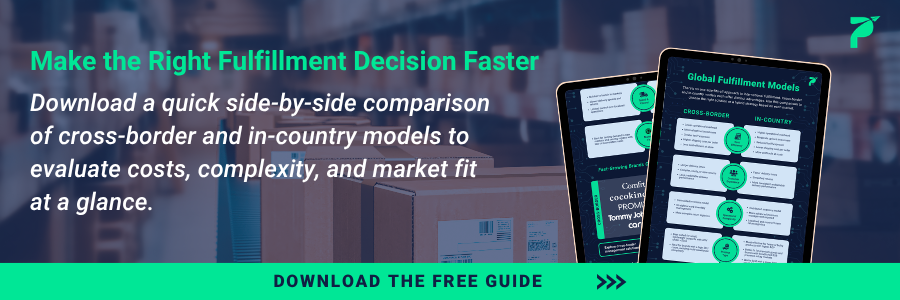
Quick Comparison Guide: In-Country vs. Cross-Border Order Fulfillment
• Minimal upfront investment
• Greater tariff exposure
• Higher shipping cost per order
• Less cost-efficient at scale
• Complex, costly, or slow returns
• Less predictable delivery performance
• Straightforward inventory management
• More complex return logistics
• Ideal for brands with a high SKU count, avoiding multi-warehouse complexity
• VAT/GST registration only required when thresholds are met (or where no exemptions apply)
• Limited exposure to local business taxes and regulations
• Slower delivery speeds and returns
• Limited control over localized operations
• Moderate upfront investment
• Reduced tariff exposure
• Lower shipping cost per order
• More profitable at scale
• Simplified returns
• More consistent and reliable delivery performance
• More advanced inventory management required
• Localized and more efficient return logistics
• Better fit for premium goods and brands with established B2B presence in key markets
• Works best with a lower SKU count (ideally ~500 or fewer)
• Local VAT/GST registration required in most cases
• May qualify as a permanent establishment, subject to local taxes and regulations
• Additional product testing and local labeling may apply
• Faster delivery speeds and returns
• Greater control over localized operations
Explore cross-border management solutions.
Learn more about in-country enablement.
Need help selecting or building a hybrid fulfillment approach? Talk to an expert.
In-Country vs. Cross-Border Ecommerce Solutions: Differentiators and Strategic Implications
Choosing the best order fulfillment strategy for your brand requires a complete understanding of your shipping logistics and the market under consideration. Consider the following factors to inform your decision.
Order Fulfillment Economics
Deciding between in-country and cross-border fulfillment has financial implications for both you and your customers.
Cross-border shipping costs less upfront. You have fewer inventories to stock, facilities to manage, and operations to fund. These features keep your overhead low, making cross-border shipping the more affordable option to get started in an international market.
But cross-border ecommerce does come with tradeoffs. International shipping costs, duties, and tariffs are often applied to orders at full retail value. While overhead can stay relatively low, per-shipment costs tend to be higher. Brands are then left deciding whether to absorb those costs or pass them on to customers, both of which can put pressure on margins as they scale.
Product characteristics also play a major role in fulfillment economics. Cross-border shipping tends to work best for small, lightweight products with lower average order values (typically under ~$350), where international shipping costs remain manageable.

For heavier, bulkier, or higher-value goods, per-order shipping costs can quickly erode margins—making in-country fulfillment a more cost-effective option as order volume grows.
This approach involves storing inventory within a target market and fulfilling orders locally, helping reduce per-order costs and delivery times.
That said, this model comes with its own considerations. It requires a greater upfront investment and higher ongoing overhead, so it tends to make the most sense in markets with consistent demand and stronger order volume.
In-country fulfillment at scale can reduce costs across several areas:
- Bulk Efficiencies – Shipping inventory in bulk is typically more cost-effective than sending individual parcels internationally. It can lower the cost per unit across packaging, transit, and handling, and may unlock more favorable, volume-based shipping rates.
- Declared Values – Shipping unsold inventory shifts your duties to a pre-retail transaction with a lower customs valuation, which can reduce the amount you owe on every unit.
- Reduced Last-Mile Costs – Shortening the distance between your inventory and customers enables the use of lower-cost, local delivery options. Fewer long-hauls and lower mileage per product trim down transportation fees at scale.
- Simplified Returns – Cross-border returns can be costly and complex. With in-country fulfillment, returns can be processed locally, reducing shipping distances, costs, and operational friction.
At a small scale, cross-border ecommerce remains the more affordable solution. But as order volume increases, (especially for higher-value, heavier, or bulkier products) an in-country strategy can offer per-shipment savings that far outweigh the added costs.
Quick Cost Comparison
Cross-Border Ecommerce
• Lower investment required
• Higher cost per order at scale
Quick Cost Comparison
In-Country Fulfillment
• Higher investment required
• Lower cost per order at scale
Customer Experience, Conversion, & Retention
Your fulfillment strategy also influences key aspects of the customer experience—such as prices, delivery times, and return policies. In this category, in-country fulfillment shines.
Cross-border fulfillment entails longer transit times and more handovers, increasing the risk of delayed, damaged, and lost orders. Each delivery step introduces vulnerabilities beyond your control, yet equally impactful to the customer. The same struggles affect return shipments, which can further frustrate a dissatisfied buyer.
Beyond the risk of a negative customer experience, slow deliveries are a leading cause of cart abandonment.
In-country fulfillment addresses all of these problems. Delivery is faster and more predictable. Returns are simpler and more accessible, enabling you to offer quick, convenient refunds.
These features are key tenets of providing a positive user experience. But even more, they’re prerequisites for a sizable share of customers.
Quick deliveries and simple return policies tend to encourage conversions, repeat purchases, and customer loyalty.
When your capabilities improve, you can make bigger promises, fulfill them, and build stronger connections with your international fans. As a result, most brands shift toward localized fulfillment as they scale.

Quick Customer Experience Comparison
Cross-Border Ecommerce
• More complex and costly returns
• Higher potential for delays and losses
Quick Customer Experience Comparison
In-Country Fulfillment
• Simpler return shipments
• Predictable, lower-risk deliveries
Operational Complexity & Inventory Strategy
Another reason to start with cross-border shipping is the model’s simplicity. With a centralized inventory, managing your stock is relatively straightforward.
Similarly, sales forecasting has fewer variables and is more concerned with total volume than regional specifics.
Serving international customers with an in-country strategy requires a distributed inventory. Storing products across multiple regions improves delivery speed, especially for difficult-to-ship items.
Still, it requires keen coordination to balance your inventory across markets (as well as cash flow to keep them stocked and operational).
SKU count is another important factor in determining operational complexity. Cross-border models are often better suited for brands with a large and diverse catalog, as they avoid the need to distribute inventory across multiple warehouses.
In-country fulfillment typically works best with a more focused SKU assortment (often ~500 or fewer), where inventory can be efficiently allocated, replenished, and managed across regions.
However, it also complicates forecasting and replenishment timelines, which must be considered for each market. These variables increase the risk of stockouts and overstocking, both of which can be costly errors.
Though the fulfillment is in-country, the supply chain is still cross-border, so using an ecommerce platform built for international shipping can lighten your logistical load.
While it comes with added complexity, in-country fulfillment makes last-mile delivery and returns much easier to manage. Keeping shipments within the country removes a lot of the friction from consumer-facing logistics.
Quick Operational Comparison
Cross-Border Ecommerce
• More complex consumer-end logistics
• Centralized inventory (better for high SKU counts)
Quick Operational Comparison
In-Country Fulfillment
• Simpler, shorter-distance consumer-end logistics
• Distributed inventory (best with a focused SKU count)
Compliance, Risk, & Market Access
International expansion involves navigating more regulations, taxes, and customs rules.
Cross-border ecommerce can involve less direct legal responsibility compared to operating locally, but it depends on your setup. In many cases, brands act as the exporter, with importer obligations varying based on shipping terms (DDU vs DDP) or whether a partner is acting as the importer of record.
In some markets, you can also avoid registering as a legal entity in the countries you ship to (as long as your sales volume remains below the local registration thresholds, where applicable).
In-country fulfillment typically requires more compliance prep, as you may take on greater importation responsibilities—including registration for value-added tax (VAT) or goods and services tax (GST) with the local jurisdiction—and may be subject to permanent establishment (PE) taxes.
The exact laws depend on the country (or countries) where you store inventory, but you can limit your legal liability by working with an international compliance partner or designating a third-party Seller of Record.
In exchange for upfront investment and added complexity, in-country fulfillment provides superior control over your brand’s presence and a stronghold for deeper market penetration.
Storing inventory in-country also grants access to certain ecommerce marketplaces, fulfillment services, and third-party logistics (3PL) providers (especially those with fast delivery standards).
Quick Regulatory Compliance Comparison
Cross-Border Ecommerce
• Simpler compliance
• Increased exposure to customs delays
• Limited access to ecommerce marketplaces
Quick Regulatory Compliance Comparison
In-Country Fulfillment
• More regulatory bodies to comply with
• Greater control over importation and delivery
• Expanded access to ecommerce marketplaces
Choosing the Right Model for Your Growth Stage
The best order fulfillment strategy depends on your order volume, business economics, margin structure, and product mix, but many brands begin with cross-border ecommerce.
Cross-border fulfillment is typically best suited for testing new markets and early-stage expansion since it allows you to start selling quickly with minimal added overhead.
In-country fulfillment becomes a more effective strategy when demand is:
- Large enough to cost more in international shipping than in-country operation.
- Consistent enough to keep ongoing operations profitable.
- Driven by higher-value, bulky, or premium products where per-order shipping costs are significant.
While establishing in-country fulfillment requires a degree of commitment, it can still be a flexible solution—especially when used alongside cross-border operations.
In practice, most brands take a hybrid approach, using cross-border fulfillment to test and scale demand, and in-country fulfillment in high-volume markets where speed and cost efficiency matter most.
The result? A more balanced strategy that adapts by market, giving brands the best of both worlds.
For more help deciding the right time to switch a foreign market to in-country fulfillment, read this article for six steps to success.
Quick Best Use Cases Comparison
Cross-Border Ecommerce
• Testing new international markets
• Low or inconsistent order volume
• Selling lightweight, lower-AOV products
• Managing a large or complex SKU catalog
Quick Best Use Cases Comparison
In-Country Fulfillment
• Well-established regional demand
• Large and sustained order volume
• Selling bulky, high-AOV, or premium products
• Operating with a more focused SKU assortment
In-Country vs Cross-Border FAQs
It’s a big decision, so we included answers to common questions.
What is the difference between cross-border ecommerce and in-country fulfillment?
Cross-border commerce ships sold products internationally from a domestic location. In-country fulfillment stores unsold inventory internationally and ships it within the same market where it’s purchased. This structural shift has far-reaching implications for both buyers and sellers.
Which is better: cross-border or in-country fulfillment?
Cross-border ecommerce is typically better for early-stage or experimental international ventures, especially for lightweight, lower-value products. In-country fulfillment is more effective at scale—particularly for higher-value or bulkier goods—but requires a highly engaged market to sustain profitability.
How do I know when to transition from cross-border ecommerce to in-country fulfillment?
The transition usually makes sense when a market’s demand is consistent, shipping costs exceed the expenses of running in-country operations, or when product characteristics (such as size, weight, or value) make cross-border fulfillment less cost-effective.
Is cross-border ecommerce more expensive than local fulfillment at scale?
It depends on the region’s typical order value and volume. In-country fulfillment yields a lower cost per order at scale, but it raises your business overhead and requires significant initial and ongoing investments. It’s critical to know the break-even point where your savings from switching to in-country fulfillment outweigh the costs.
How does in-country fulfillment impact international conversion rates?
Faster delivery, lower pricing, and easier returns generally improve conversion and customer retention.
Do I need a cross-border ecommerce platform to sell internationally?
No, but using a specialized platform or ecommerce partner can simplify logistics, compliance, and inventory management. For example, Passport Global centralizes all those functions in one hub for convenient cross-border management.
What are the biggest risks of storing inventory in-country?
Top risks include:
- Higher upfront investment
- Increased inventory complexity
- Additional compliance requirements
If improperly managed or poorly planned, an in-country fulfillment system will cost more than it’s worth. But prepared organizations can reap significant benefits from a proper strategy, including sustained international expansion.
Does product type affect whether I should use cross-border or in-country fulfillment?
Yes. Product characteristics like size, weight, and average order value can significantly impact fulfillment costs. Cross-border shipping is typically more efficient for small, lightweight, lower-value items, while in-country fulfillment is often more cost-effective for bulky, heavy, or higher-value products where international shipping costs are higher.