



For many ecommerce brands, expanding into Europe feels like the natural next step in global growth. The market is large, digitally mature, and highly attractive for cross-border commerce. But once brands begin shipping products into the European Union, one question quickly becomes unavoidable:
What import tariffs should we expect?
Tariffs are one of the most misunderstood parts of international ecommerce. Many brands assume there is a single “Europe tariff” applied uniformly across all imports, when in reality EU import costs depend on a combination of product classification, declared value, country of origin, and local tax requirements.
Understanding how EU import tariff rates work is essential for protecting margins, pricing products accurately, and avoiding unexpected customs costs that disrupt the customer experience.
What EU import costs should brands expect?
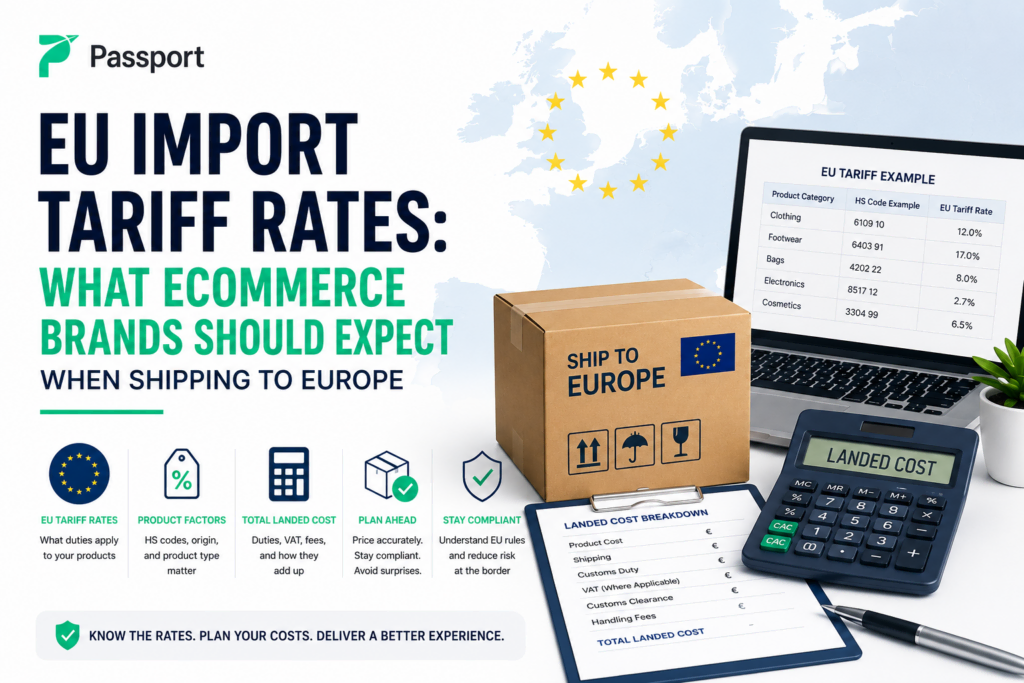
When shipping into the EU, brands typically encounter three major cost layers:
- Customs duty (tariffs): driven by HS code, country of origin, and customs valuation
- Import VAT: generally applies to imported goods, with rates varying by destination country. Certain products may also have a reduced or zero tax rate.
- Handling and clearance fees: charged by carriers, brokers, postal operators, or customs intermediaries
Starting in 2026, the EU is introducing major reforms for ecommerce imports that will change how duties and related fees apply to all e-commerce shipments.
For ecommerce brands, these costs directly impact landed cost, pricing strategy, and customer experience.
How EU import tariffs work
When goods enter the European Union, customs authorities may apply import duties based on both the product category and where the goods were manufactured.
The EU operates as a customs union, meaning member states generally apply a common external tariff framework. Compared to regions where every country maintains separate tariff systems, this creates more consistency across European markets.
However, products are not treated equally.
Tariff rates vary significantly depending on the goods being imported. Apparel, footwear, electronics, cosmetics, supplements, luxury products, and home goods can all face different duty structures. In some cases, duties may be relatively low. In others, they can materially affect profitability.
For ecommerce brands, tariffs are not simply a logistics issue. They are a core part of international unit economics. Before duties can even be calculated, businesses must navigate product classification, customs procedures, import requirements, and regulatory compliance. For brands entering Europe for the first time, these steps can be just as important as the tariff itself.
Tariffs vs. duties vs. VAT vs. handling fees
Brands often use the term “tariffs” to describe all import-related charges. In practice, EU import costs usually include several distinct components:
Customs duty (tariff)
This is the import duty assessed based on the product’s HS code, country of origin, and declared customs value.
Import VAT
VAT applies broadly to imported goods entering the EU. The applicable rate depends on the destination country and is typically one of the largest components of landed cost.
Handling and clearance fees
These are operational processing fees assessed by carriers, brokers, postal operators, or customs-related mechanisms during import clearance.
This distinction matters because many brands underestimate their true landed costs when entering Europe, especially if they want to offer a DDP (Delivered Duty Paid) experience where customers see the full cost upfront at checkout.
Why product classification matters
EU customs authorities rely on Harmonized System (HS) codes to determine how imported products should be classified and what tariff rates apply.
Even small differences in classification can affect duty exposure.
Two products that appear commercially similar may receive different tariff treatment depending on:
- material composition
- product function
- manufacturing details
- intended use
Here is an example:
Consider two products that could plausibly sit side by side in a brand’s catalog: a leather-upper sneaker and a textile-upper sneaker. Both have rubber outsoles. Both are marketed as lifestyle footwear. Both might even retail at the same price point. But under EU customs rules, they fall into entirely different HS headings therefore, carry starkly different duty obligations.
The leather-upper sneaker classifies under HS 6403 (footwear with outer soles of rubber, plastics, or leather and uppers of leather), which carries an EU Most Favored Nation (MFN) duty rate of 5–8% under the Common Customs Tariff. The textile-upper sneaker — think mesh, knit, or canvas construction — classifies under HS 6404 (same outer soles, uppers of textile materials), which carries an MFN duty rate of approximately 17%.
Incorrect classification creates significant operational risk. Brands may underpay duties, overpay unnecessarily, or trigger customs reviews and shipment delays.
As international order volume grows, classification accuracy becomes increasingly important because tariff exposure compounds across thousands of shipments.
For ecommerce brands, HS code quality is both a compliance requirement and a margin protection strategy.
Why tariff rates vary by country of origin
The EU’s tariff structure depends not only on the product itself, but also on where the product was manufactured.
The European Union maintains various trade agreements and preferential tariff arrangements with certain countries. Products manufactured in eligible regions may qualify for reduced duties under specific trade programs.
At the same time, goods imported from countries facing trade restrictions or heightened scrutiny may encounter higher import costs.
This is why country of origin (COO) is not simply a shipping detail. It is a critical landed-cost variable.
For brands sourcing products globally, origin strategy can materially affect import economics.
Common ecommerce categories with higher tariff sensitivity
Certain ecommerce categories tend to face more complex tariff exposure when entering Europe.
Fashion and apparel
Fashion brands often encounter layered tariff structures based on:
- fabric composition
- garment category
- manufacturing origin
- construction details
Beauty and cosmetics
Beauty products may face both import duties and additional EU regulatory requirements tied to product safety, labeling, and compliance standards.
Electronics
Electronics imports often involve tariff considerations alongside environmental compliance obligations, certifications, and recycling regulations.
Home goods and lifestyle products
Even seemingly simple household products may require careful classification depending on their materials and construction.
As product assortments diversify, tariff planning becomes increasingly important across the business.
2026 update: EU low-value import reforms (€150 and below)
Beginning July 1, 2026, the European Union will phase out the €150 duty de minimis exemption for ecommerce imports. As part of the reform, shipments entering the EU may become subject to new flat-rate customs duties, handling fees, and expanded customs reporting requirements. For shipments cleared on or after July 1, 2026, a €3 flat-rate duty will apply per customs declaration line item for goods valued at €150 or less. Separately, a €2 customs handling fee per customs declaration line item is expected to apply to all ecommerce imports no later than November 1, 2026. In parallel, several Member States, most notably France, Italy, and Romania, have moved ahead with national clearance or handling fees. These charges are legally distinct from VAT and customs duty, creating a multi-layered tax environment for low-value e-commerce imports.
Read our EU Customs Development guide for the latest confirmed developments, what they mean for ecommerce merchants, and how Passport is preparing to support brands through the transition.
DDP vs. DDU: why the shipping model matters
The shipping model brands choose can significantly affect customer experience in Europe.
DDU (Delivered Duty Unpaid)
With DDU shipping, customers may be asked to pay VAT, duty, and clearance fees at delivery.
This often leads to:
- surprise charges
- refused deliveries
- increased support tickets
- lower conversion rates
DDP (Delivered Duty Paid)
With DDP shipping, the brand estimates and pays import costs upfront, creating a more predictable customer experience and reducing delivery friction. While DDP adds operational complexity, brands focused on conversion and customer satisfaction often find it worthwhile.
For a deeper breakdown, read our guide to DDU vs. DDP shipping.
Why brands struggle with EU tariff management
Many ecommerce companies first encounter tariff issues after shipments begin experiencing delays, unexpected costs, or customs holds.
Common challenges include:
- incomplete product descriptions
- inaccurate HS classifications
- inconsistent country-of-origin data
- unclear importer structures
- fragmented VAT workflows
Complexity increases further when brands expand across multiple EU markets simultaneously.
Although the EU maintains a unified customs framework, operational workflows, VAT registration requirements, and delivery expectations can still vary between countries.
As shipment volume grows, manual processes become increasingly difficult to manage consistently.
This is one reason many brands invest in centralized cross-border infrastructure, including:
- Importer of Record (IOR) programs
- landed-cost calculation systems
- VAT automation
- customs data management tools
How Passport helps brands ship to Europe
Passport helps you ship across the EU with a single platform that handles cross-border logistics and compliance end to end so you can offer a fast, reliable customer experience while staying on top of duties, taxes, and evolving customs requirements.
With Passport, brands can simplify EU compliance and importer complexity with our Seller of Record (SoR) solution, which helps manage the legal and tax responsibilities required to sell into supported EU markets, so you can expand internationally without building a patchwork of local entities and registrations.
Accelerate market expansion with In-Country Enablement, which helps brands launch and scale in key international markets with the infrastructure needed to operate locally (including localized compliance, delivery experience, and ongoing operational support).
As EU ecommerce import reforms roll out in 2026 having the right importer and in-country operating model becomes a competitive advantage
Reach out to see how Passport can help you launch, scale, and ship to Europe with confidence.
Frequently Asked Questions
What are EU import tariff rates?
EU import duty rates vary depending on the product’s HS code and country of origin. There is no single universal “EU tariff” applied to all products.
Do brands always have to pay VAT when shipping to Europe?
In most cases, imported goods entering the EU are subject to VAT. The applicable VAT rate depends on the destination country.
What is the EU €150 threshold?
The €150 low-value threshold is based on intrinsic value, meaning the product value excluding shipping and insurance costs.
What changes on July 1, 2026?
The EU is ending the €150 duty de minimis exemption for low-value ecommerce imports and introducing new duty mechanisms for qualifying shipments.
Should brands choose DDP or DDU shipping?
Brands prioritizing customer experience and conversion rates often prefer DDP because it reduces surprise charges at delivery. DDU can reduce operational complexity upfront but increases the risk of customer friction and refused shipments.
What determines EU import duty rates?
Import duty rates are primarily determined by a product’s HS code, country of origin, and customs value. Similar products can face different duty rates depending on how they are classified and where they were manufactured.
What is an HS code, and why does it matter?
An HS (Harmonized System) code is a standardized product classification used by customs authorities worldwide. The HS code helps determine which tariff rate applies to an imported product and is critical for customs compliance.
Does the country a product ships from affect EU tariffs?
Not necessarily. Customs authorities generally focus on the product’s country of origin (where it was manufactured), not the country from which it was shipped. Two identical products shipped from the same warehouse may face different tariff treatment if they were manufactured in different countries.
What is landed cost?
Landed cost is the total cost of getting a product to the customer, including product cost, shipping, customs duties, VAT, handling fees, and other import-related charges. Understanding landed cost is essential for accurate pricing and margin management.
Can incorrect product classification cause customs delays?
Yes. Incorrect HS classifications can lead to customs reviews, shipment delays, duty reassessments, penalties, or overpayment of duties. Accurate product data is an important part of cross-border compliance.
How will the 2026 EU low-value import reforms affect ecommerce brands?
Beginning July 1, 2026, the EU will remove the €150 duty de minimis exemption and introduce new customs charges and reporting requirements for low-value imports. Brands shipping large volumes of low-value orders may need to reassess landed-cost calculations, checkout pricing, and shipping strategies.

Authored by Thomas Taggart
Head of Global Trade | Passport
Thomas Taggart is a cross-border commerce leader with more than 20 years of experience in international shipping and regulatory affairs. As the Head of Global Trade, Thomas helps ecommerce brands go global by simplifying international trade, tax, and product compliance issues. Prior to Passport, he brought international shipping solutions to market through multiple roles in UPS’s product development organization.