


Selling into the European Union (EU) offers ecommerce brands access to one of the world’s largest cross-border markets. . As a matter of fact, in Europe, more than 216 million online consumers purchased from abroad.Figures like that not only prove the strength of the EU market, but also the revenue opportunities for e-commerce brands that want to start exporting to Europe. While businesses shipping to Europe should understand requirements around VAT, customs, and product compliance, the process is far more manageable with the right shipping strategy and technology partner. With the proper setup, importing products into the EU can become a scalable and profitable part of your international growth strategy.
Selling Online to Europe: A Beginner’s Checklist to EU Imports
Whether you want to sell food products or ship cosmetics to Europe, the first step is to assess whether this will be profitable for your organization.
Step 1: Conduct EU Market Research
Like in every import/export trade venture, you should start your online sales in the EU by conducting preliminary market research.
Try addressing questions like these:
- Do your products have in-built demand?
- Are there cheaper domestic or foreign competitors?
- Do you have a marketing plan with a viable sales strategy?
- Have you identified online distribution channels?
These questions will help you assess your options and odds of success.
Ready? Now it’s time to put your plan into action.
Step 2: Understand EU Product Compliance Requirements
Here are some essential requirements when exporting to Europe:
- Your products must meet relevant EU regulations regarding the protection of human and animal health, the environment and consumers rights.
- All your European customers must be offered the same sales conditions (e.g., special prices or promotions) despite the country they live in.
- Oftentimes, your EU buyers are obliged to have the same access to your goods as your local customers. Nevertheless, you are free to define your general terms and conditions of sale, including delivery limitations.
- Your potential EU customers must be able to access any part of your website they want without any restrictions. For example, suppose they type in an Italian URL of your online store, but they are connected from Spain. In that case, they shouldn’t be automatically redirected to your Spanish version. They must first give their consent.
- Your EU online sales and digital marketing strategies must be GDPR compliant. This strict data-protection protocol is mandatory for all e-commerce brands dealing with exports to the EU. GDPR compliance practices include minimal data collection, restricted access to databases, immediate deletion of data upon user request, and more.
- Stay up to date with the latest EU customs changes affecting ecommerce, including updates to IOSS, the removal of the €150 de minimis duty exemption, new import fees, DDU restrictions, and key implementation dates. For the latest developments, see our continuously updated guide: EU Customs Changes 2026: An Ongoing Guide for Ecommerce Imports.
Step 3: Understand EU VAT Requirements
Every country in the EU applies its own import VAT (Value- Added Tax). This VAT rate varies between 17% and 27%, depending on the destination country.
While the consumer ultimately bears the tax cost, the legal responsibility for collecting and remitting the VAT depends on your shipping model
Note that every EU country may have different VAT remittance rules within the general EU VAT framework.
Wondering how much duty your products may actually pay? Learn how EU import tariff rates are determined, when the new €3 flat duty applies, and when standard customs tariffs may still be charged in our guide: EU Import Tariff Rates: What Ecommerce Brands Should Expect When Shipping to Europe.
EU VAT Clearance – IOSS
For business-to-consumer (B2C) shipments valued at €150 or less, the Import One-Stop Shop (IOSS) is the primary mechanism for simplifying VAT compliance.
Registering for IOSS provides your business with a unique IOSS identification number. When you share this number electronically with your carrier during customs entry, it serves as verification that VAT was prepaid at checkout. This allows you to report and pay all your EU-wide import VAT together under a single monthly tax return, completely eliminating the need to maintain separate local tax registrations in every EU Member State
What are the benefits of IOSS?
With an IOSS number, e-commerce businesses that sell in Europe are able to:
- Speed up customs clearance
- Claim VAT refunds on returned items
- Expedite the whole import process
- Minimize door-to-door delivery times
To use the IOSS system, you need to apply and pay for an IOSS number, deal with the safekeeping of records for 10 years, handle monthly remittances, and more.
Even with the introduction of the new low-value flat duties, IOSS remains the most critical compliance and logistics tool for shipping to the EU. Read more in our Benefits of IOSS guide.
But what about EU orders over €150?
As of July 1, 2026, the EU has officially eliminated the €150 duty-free de minimis threshold. Under these live rules, low-value B2C shipments (€150 or less) cleared via the IOSS flow are automatically assessed a temporary €3 flat-rate customs duty per customs declaration line item. This temporary bridging rate is expected to remain in place until 2028, when the centralized EU Customs Data Hub goes live.
As the EU continues implementing customs reforms, businesses should monitor changes to ecommerce import procedures and low-value shipment rules.
Step 4: Prepare EU Customs Documentation
Accurate customs documentation is critical for successful EU imports.
Most shipments entering the EU require:
- commercial invoices
- product descriptions
- HS (Harmonized System) codes
- declared values
- recipient information
- country of origin data
Customs Regulations for Shipping in the EU (ICS2)
Before you start selling cross-border to the EU, you should familiarize yourself with international customs procedures and EU import regulations.
In the last year, merchants and carriers must comply with the ICS2 risk-assessment protocol.
This means that they must provide and submit detailed order/recipient information and commodity codes (HS numbers) for every order so that it can pass the pre-loading and pre-entry stages according to the ICS2 risk prevention procedures of the EU customs authorities.
Step 5: Choose the Right Shipping and Compliance Strategy
For many ecommerce businesses, managing EU VAT requirements, customs compliance, duty calculations, import clearance, carrier coordination, and returns can become increasingly time-consuming as international operations grow. That’s why many brands partner with cross-border logistics providers that specialize in simplifying global ecommerce shipping and compliance.
Depending on your business model, solutions may include:
-
Seller of Record (SOR) services
-
IOSS management
-
Delivered Duty Paid (DDP) shipping
-
landed cost calculations
-
automated tax and duty collection
-
localized checkout experiences
Don’t Know Where to Start? Passport Can Help!
At Passport, we can manage your EU export shipping for you! Our customizable solutions assist online merchants handle order registrations, fees, taxes, and more.
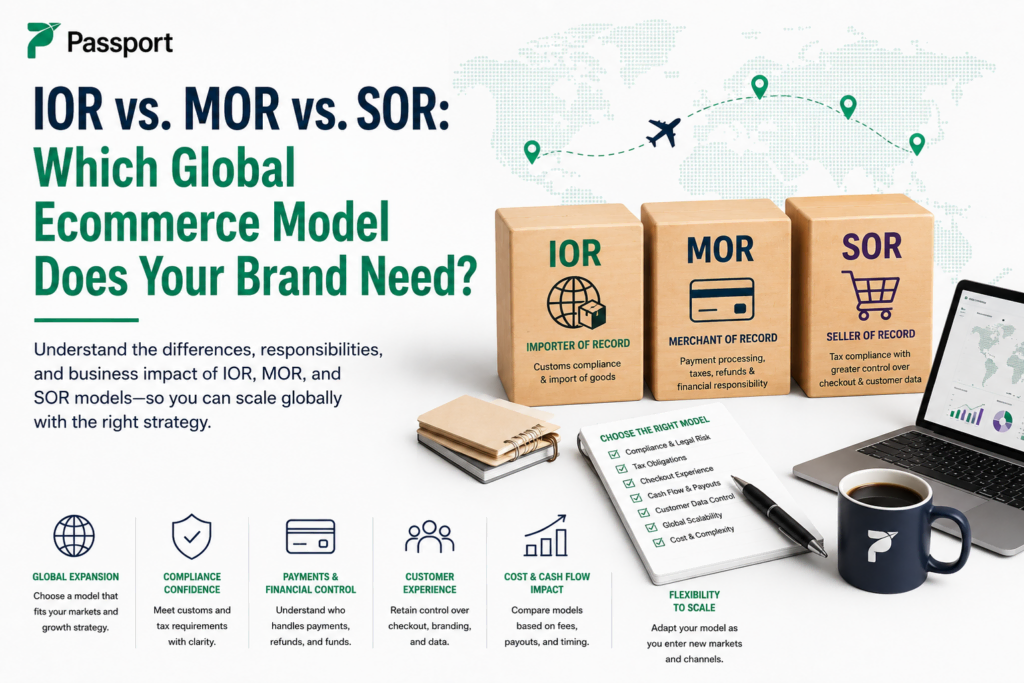
Our Seller of Record® (SOR) model is designed to support your e-commerce business access the EU market with ease. At Passport, we aim for seamless experiences for sellers and buyers alike.
Using Passport’s SOR Program will allow you to:
- avoid complex registrations and filings
- use Passport’s IOSS number
- have your VAT returns taken care of (by us!)
- get expert guidance on EU import issues
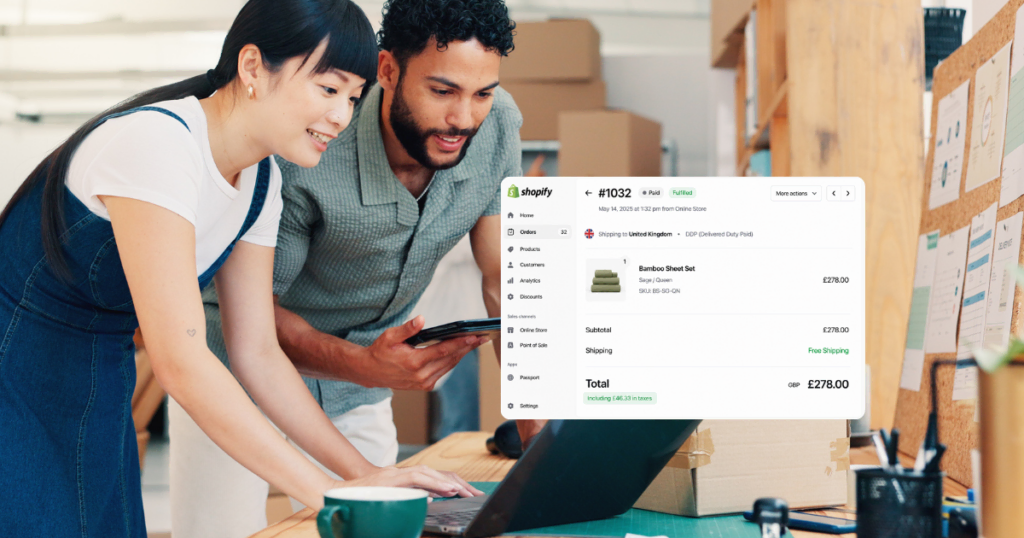
As for your shop’s front end, we facilitate the checkout process with our integrated duty and tax calculator solution – easily embedded in Shopify, BigCommerce, or WooCommerce.
Aside from VAT, there are additional regulations for shipping to the EU.
If you are just starting to deal with cross-border e-commerce and EU imports, contact our sales team to find out how we can help!
Frequently asked questions
How much does it cost to import products into the EU?
The total cost of importing products into the EU may include:
- shipping costs
- import VAT
- customs duties
- carrier fees
- customs brokerage charges
- compliance and documentation costs
The final landed cost depends on the product category, shipment value, country of origin, and destination country.
Do all products require customs clearance in the EU?
Yes. Goods entering the EU generally require customs processing and import documentation, even for ecommerce shipments. The level of customs review and applicable duties may vary depending on the shipment value and product type.
What are HS codes?
HS codes (Harmonized System codes) are international product classification codes used by customs authorities to identify imported goods.
Accurate HS codes help determine:
- customs duties
- VAT treatment
- import restrictions
- product compliance requirements
Incorrect HS codes can lead to customs delays, penalties, or additional inspections.
How long does customs clearance take in the EU?
EU customs clearance timelines vary depending on:
- shipment documentation
- product category
- customs review requirements
- carrier processes
- destination country
Shipments with complete and accurate customs data typically clear much faster than shipments with missing or incorrect information.
What is the difference between VAT and customs duties?
VAT is a consumption tax applied to goods sold within the EU, while customs duties are import taxes applied to certain goods entering the EU from outside the region.
A shipment may be subject to:
- VAT only
- duties only
- or both VAT and duties
depending on the product and shipment value.
Can US businesses sell directly to EU consumers?
Yes. US ecommerce businesses can sell directly to EU consumers, but they must comply with applicable EU VAT, customs, product safety, and consumer protection regulations.
What products are restricted or regulated in the EU?
Certain products entering the EU may face additional regulations or restrictions, including:
- food and beverages
- cosmetics
- medical devices
- supplements
- electronics
- children’s products
- chemicals
Some products may require certifications, labeling, or additional documentation before import.
Do I need a customs broker to import into the EU?
Not always. Many ecommerce shipments are handled directly by carriers or cross-border logistics providers. However, customs brokers can help businesses manage import compliance, documentation, duties, and customs clearance procedures.
What shipping terms are best for EU ecommerce orders?
Many ecommerce brands prefer Delivered Duty Paid (DDP) shipping because it creates a smoother customer experience by collecting duties and taxes upfront before delivery.
This helps reduce:
- unexpected fees
- delivery delays
- refused shipments
- customer support issues
How do I import products into the EU?
Businesses importing products into the EU typically need to:
- Ensure products meet EU compliance requirements
- Prepare customs documentation
- Manage VAT obligations
- Classify products with HS codes
- Coordinate customs clearance and shipping
Do I need an IOSS number to sell in Europe?
Not always. IOSS is optional, but many ecommerce brands use it for eligible low-value shipments because it simplifies VAT collection and improves the customer experience.
What documents are needed to import goods into the EU?
Common import documents include:
- commercial invoices
- customs declarations
- HS codes
- shipping documentation
- product compliance certificates (when applicable)
What is ICS2?
ICS2 is the EU’s customs security system used to assess shipment risk before goods enter Europe.
Does IOSS eliminate customs duties?
No. IOSS simplifies VAT collection, but customs duties may still apply depending on shipment value, product classification, and EU customs rules.