


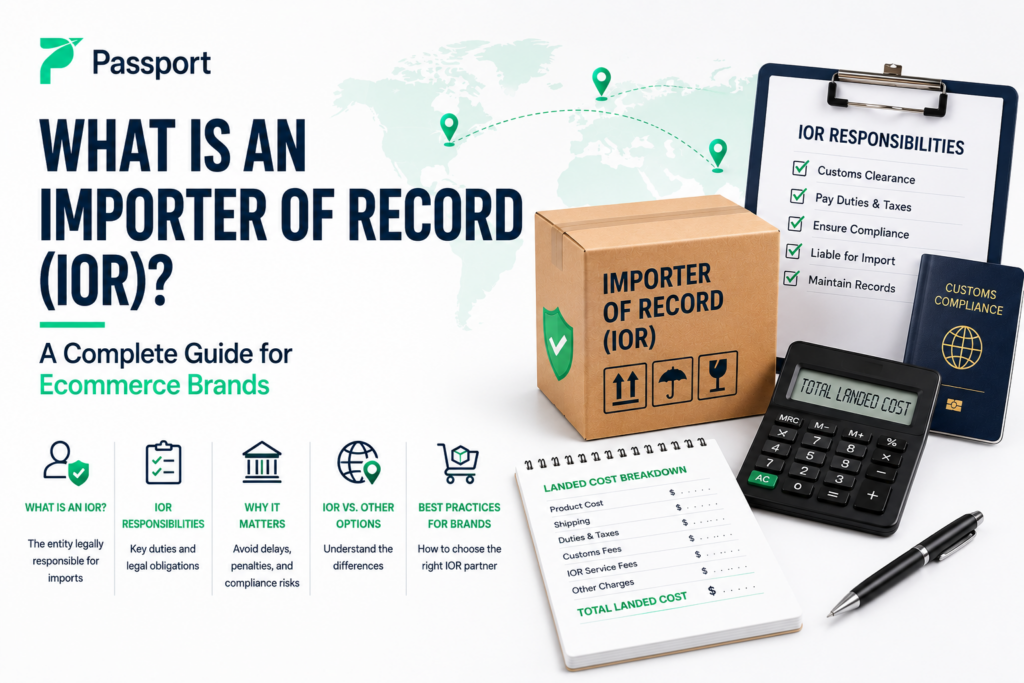
An Importer of Record (IOR) is the party legally responsible to customs for goods entering a country, including their declaration, classification, duties, and import taxes.
The IOR files import documentation, pays duties and taxes, and is the party customs authorities hold accountable when goods enter a country — whether that’s the brand itself, a local entity, or a third-party provider.
For ecommerce brands expanding internationally, the IOR plays a foundational role in helping shipments move through customs efficiently, ensuring duties and taxes are handled properly, and supporting compliance with local import requirements.
As cross-border ecommerce continues to scale, understanding the Importer of Record role is becoming increasingly important for brands looking to create reliable, predictable, and seamless international delivery experiences.
What Is an Importer of Record (IOR)?
An Importer of Record (IOR) is the party legally responsible to customs for goods entering a country, including their declaration, classification, duties, and import taxes.
The Importer of Record is just one part of the broader international ecommerce operating model. Brands also need to decide who acts as the Merchant of Record (MOR) and Seller of Record (SOR), depending on how they want to manage payments, tax liability, and customer transactions. For the full decision framework, see IOR vs. MOR vs. SOR: Which Global Ecommerce Model Does Your Brand Need? — or compare the two tax-side models directly in Merchant of Record vs. Seller of Record.
The IOR assumes responsibility for:
- Filing import documentation
- Paying duties and taxes
- Ensuring regulatory compliance
- Maintaining import records
- Managing customs clearance requirements
In simple terms, the IOR is the party customs authorities hold accountable when goods enter a country.
Depending on the shipment structure, the IOR may be:
- The ecommerce brand
- A local entity
- A distributor
- A third-party compliance provider
- A logistics partner acting on behalf of the importer
Why does the Importer of Record matter in ecommerce?
Every country has its own customs procedures, import regulations, tax structures, documentation standards, and product compliance requirements. What works in one market may require additional approvals or certifications in another.
The Importer of Record helps create accountability within that process.
Without a clearly established IOR structure, shipments may encounter customs delays, inconsistent duty treatment, or documentation issues that impact delivery performance and customer experience.
For ecommerce brands, this matters because international customers increasingly expect cross-border orders to feel just as seamless as domestic ones. They expect transparent pricing, predictable delivery timelines, and minimal friction during checkout and delivery.
Behind the scenes, the Importer of Record plays an important role in supporting that experience.
What are the responsibilities of an Importer of Record?
The Importer of Record is responsible for ensuring imported goods comply with the destination country’s customs and regulatory requirements.
This typically includes managing import documentation, overseeing duties and taxes, maintaining compliance records, and helping ensure products meet applicable local regulations before entering the market.
Depending on the product category, the IOR may also help support:
- labeling requirements
- product certifications
- safety standards
- environmental regulations
- or other country-specific import obligations
Because customs authorities use import documentation to determine whether goods can legally enter a country, accuracy and consistency are essential for maintaining smooth cross-border operations.
The IOR also assumes financial responsibility for import-related obligations tied to the shipment, including duties, import VAT, GST, tariffs, and other border-related fees where applicable.
In many countries, import documentation must also be retained for several years after the shipment clears customs.
In other words, the Importer of Record is not simply facilitating paperwork — it is the party legally accountable for the import transaction itself.
Importer of Record vs. Customs Broker
Why do ecommerce brands use Importer of Record services?
Many ecommerce brands begin expanding internationally long before establishing legal entities abroad.
As global sales grow, brands often look for ways to simplify import operations while creating a more localized customer experience in new markets.
This is where Importer of Record services become valuable.
Rather than establishing subsidiaries in every country they ship into, brands can work with experienced IOR providers that manage import responsibility on their behalf. This allows ecommerce companies to enter new markets more efficiently while maintaining compliance with local import requirements.
For growing ecommerce brands, this can help simplify:
- international market entry
- customs compliance workflows
- landed cost management
- duties and taxes
- and cross-border operational processes
The role becomes especially important in shipping models like Delivered Duty Paid (DDP), where brands want duties and taxes managed upfront as part of a seamless customer experience.
Marketplace expansion can create additional IOR considerations as well. For example, ecommerce brands selling internationally through marketplaces like Amazon FBA are often still responsible for establishing a compliant importing structure when inventory moves across borders.
This approach is especially common in Canada, where many U.S. ecommerce brands use a Non-Resident Importer (NRI) model to sell directly to Canadian consumers without establishing a Canadian entity. Learn more in our Complete Guide to Canada’s Non-Resident Importer (NRI) Program.
Carriers, brokers, and 3PLs: who is (and isn’t) the IOR?
One of the most common misconceptions in global ecommerce is assuming that a carrier, customs broker, or 3PL automatically handles Importer of Record responsibilities.
In reality, these roles are very different.
A carrier’s primary responsibility is transportation. Companies like DHL, UPS, or FedEx move shipments across borders and facilitate delivery logistics, but they are not typically assuming legal responsibility for the import itself.
Similarly, a customs broker helps prepare and submit customs documentation, coordinate clearance procedures, and communicate with customs authorities. While brokers play a critical operational role, they generally do not become the legal Importer of Record unless explicitly structured to do so.
Third-party logistics providers (3PLs) also focus primarily on warehousing, fulfillment, and inventory movement. Even when they support international shipping workflows, they may not assume the legal liability associated with importing products into a country.
That distinction matters because customs authorities ultimately want a clearly identifiable party that is legally accountable for the shipment. If documentation issues arise, duties are unpaid, or products fail to meet regulatory requirements, responsibility falls on the Importer of Record.
An effective IOR structure closes that gap by creating clear legal accountability for the import process itself, not just the movement of goods.
What happens without a strong IOR structure?
Many ecommerce brands only realize the importance of the IOR after something goes wrong.
A shipment may become stuck in customs unexpectedly. Duties may be reassessed, or documentation may be rejected. In more serious cases, products can be seized or subject to regulatory investigation.
These issues are not just operational inconveniences since they can directly impact revenue, customer trust, and market expansion efforts.
Customs delays often create cascading problems for ecommerce businesses. Customers may experience extended delivery times, refunds may increase, and support teams may become overwhelmed handling shipment inquiries.
At the same time, financial exposure can grow quickly. Penalties for noncompliance, incorrect classification, or unpaid duties can become expensive, especially for brands shipping at scale.
There is also a reputational component to consider. International customers increasingly expect a localized experience, and customs disruptions can undermine confidence in a brand’s ability to deliver globally.
As cross-border ecommerce continues to grow, compliance infrastructure is becoming just as important as logistics infrastructure.
How do Importer of Record services work?
While every provider operates differently, most Importer of Record services follow a similar process.
The relationship usually begins with a review of the products being imported and the destination market. This helps determine any import requirements tied to product classification, documentation, regulatory standards, or customs treatment.
From there, the IOR provider typically helps support:
- customs preparation
- import documentation
- classification codes
- duties and taxes
- and customs clearance coordination
When shipments arrive in the destination country, the Importer of Record assumes responsibility for the import process under the established importing structure.
For ecommerce brands, the goal is not simply moving products across borders. It is building a scalable and repeatable framework that supports long-term international growth.
How does Passport support Importer of Record operations?
Moving inventory into a new market often breaks down at the same point: a brand wants to hold stock in-country, but can’t legally import it without the right local setup—and a party that customs can hold accountable.
That’s what the Importer of Record (IOR) role provides. The IOR is the entity responsible for the import, including compliant documentation and the payment of applicable duties and taxes.
IOR works best when it’s not treated as a standalone fix
Passport’s IOR capability is offered as part of our broader in-country solution, not as a one-off add-on. That’s because import compliance is tightly connected to how inventory moves, how shipments are cleared, and how responsibilities are managed across partners.
When the import process is fragmented across carriers, brokers, and internal teams, the risk of delays and preventable mistakes goes up. Passport helps reduce that complexity by owning the IOR role in supported markets—so accountability is clear and execution is consistent.
What Passport handles as Importer of Record
When Passport acts as IOR, we support the import process end-to-end, including:
- Import documentation accuracy and completeness
- Customs clearance coordination
- Responsibility for duties and taxes, backed by the compliance rigor those payments require
By centralizing the IOR function within a broader in-country operating model, Passport helps brands reduce customs friction and scale international growth with more confidence.
Want to explore in-country fulfillment options for your top markets?

Authored by Thomas Taggart
Head of Global Trade | Passport
Thomas Taggart is a cross-border commerce leader with more than 20 years of experience in international shipping and regulatory affairs. As the Head of Global Trade, Thomas helps ecommerce brands go global by simplifying international trade, tax, and product compliance issues. Prior to Passport, he brought international shipping solutions to market through multiple roles in UPS’s product development organization.
Frequently Asked Questions
What is an Importer of Record (IOR)?
An Importer of Record (IOR) is the party legally responsible for customs for goods entering a country, including their declaration, classification, duties, and import taxes.
The IOR is accountable for customs compliance, import documentation, duties and taxes, and ensuring shipments meet local regulatory requirements.
In international ecommerce, the IOR plays a critical role because customs authorities need a clearly identified party responsible for the import transaction. Without a valid IOR structure, shipments may face delays, holds, or rejection at the border.
What does Passport do as the Importer of Record?
Passport acts as the legal Importer of Record in supported markets as part of a broader in-country enablement model, managing the compliance and import process on behalf of ecommerce brands.
This includes overseeing import documentation, coordinating customs clearance, managing duty and tax obligations tied to the import, and helping ensure shipments comply with local import requirements. By centralizing the importer role, Passport helps brands simplify cross-border operations and reduce compliance friction.
Can a carrier, customs broker, or 3PL act as the Importer of Record?
Not necessarily. Carriers, customs brokers, and 3PLs often support transportation, customs filing, or logistics operations, but they are not automatically the legal Importer of Record.
The IOR is the party that customs authorities hold legally responsible for the import itself, including compliance, duties, taxes, and regulatory obligations. Passport’s program is specifically structured so Passport acts as the IOR in supported markets as part of a broader in-country enablement model, rather than simply facilitating the shipment process.
Do brands need a local entity to sell internationally when using Passport IOR?
Often, no. With Passport, many brands can start selling internationally without setting up a local entity because in our standard cross-border model, the consumer is the Importer of Record (IOR) and duties/taxes are collected and paid at checkout to support a DDP-like delivery experience.
In Seller of Record markets, Passport’s tax ID may appear in the shipment data; that makes Passport accountable for VAT/GST on low-value goods, but the consumer remains the importer.
As volume grows, some brands choose to “localize” (for example, in-country fulfillment/warehousing) to improve speed, cost, and control. Passport’s IOR capability is part of our in-country enablement offering in supported markets, where Passport assumes import responsibility as part of a broader localized fulfillment model.
How does an Importer of Record help prevent customs delays and shipment holds?
A properly structured Importer of Record program helps reduce customs issues by ensuring importer responsibility, documentation, and compliance processes are clearly managed.
Common cross-border problems — including shipment holds, rejected entries, documentation errors, and unexpected import fees — often happen when importer responsibilities are unclear or compliance requirements are incomplete. A centralized IOR model helps create more consistent import workflows and reduces preventable customs friction.
Who pays duties and import taxes when using an Importer of Record?
The Importer of Record is generally responsible for duties, import taxes, tariffs, and other border-related fees associated with bringing goods into a country.
When Passport acts as Importer of Record in supported in-country markets, Passport assumes responsibility for those import obligations. In Passport’s standard cross-border model, the consumer is the importer.
What products require special Importer of Record compliance?
Certain product categories may require additional import compliance review depending on the destination country’s regulations.
Products such as electronics, cosmetics, supplements, medical devices, and regulated consumer goods may face stricter import requirements related to labeling, safety standards, certifications, or restricted goods rules. Passport evaluates product eligibility and compliance requirements as part of the onboarding process for supported markets.
What’s the difference between an Importer of Record and a customs broker?
An Importer of Record and a customs broker serve different functions in the import process.
The Importer of Record holds the legal responsibility for importing goods into a country, including compliance, duties, taxes, and regulatory obligations. A customs broker, on the other hand, helps facilitate customs clearance by preparing and submitting documentation on behalf of the importer.
In many cross-border ecommerce operations, both roles work together: the customs broker manages the clearance process, while the IOR assumes legal accountability for the import.
Can Amazon act as the Importer of Record?
Usually, no. Amazon typically does not act as the Importer of Record for third-party sellers using marketplace or FBA programs.
In most cases, the seller remains responsible for establishing a compliant importing structure and ensuring customs obligations are properly handled. This is one reason many international ecommerce brands use third-party IOR solutions when shipping inventory into foreign markets.
Can a foreign company act as the Importer of Record?
It depends on the country. Some markets allow foreign entities to act as the Importer of Record, while others require a locally registered entity to assume the role.
In the U.S., the rules are tightening: see how EO 14411 changes who can act as a U.S. Importer of Record.
Because import regulations vary significantly across jurisdictions, brands expanding internationally often use local IOR solutions to navigate country-specific requirements without establishing their own in-country entities first. Canada is one of the best-known examples of a country that allows qualifying foreign businesses to operate as a Non-Resident Importer (NRI), enabling brands to import goods without establishing a Canadian legal entity. Read our Canada NRI Guide to learn how the program works and when it makes sense.
What’s the main benefit of using Passport as the Importer of Record?
The main benefit is that brands can sell and deliver in-country without creating their own importer entity. This is part of Passport’s in-country enablement (not standard cross-border shipping). When Passport acts as the Importer of Record, Passport helps brands import products without needing to establish local importer entities themselves. This creates a more centralized and manageable cross-border process while helping reduce customs friction and importer-related risk.