


Import One-Stop Shop (IOSS)
For brands selling or importing goods into the European Union (EU), the July 1, 2021 VAT reforms introduced streamlined ways to manage value-added tax (VAT) on cross-border ecommerce shipments.
Today, non-EU sellers shipping goods directly to EU consumers can use three primary methods to account for import VAT:
- Standard Customs Procedure
- Special Arrangement
- Import One-Stop Shop (IOSS)
IOSS was originally introduced to simplify VAT collection for low-value ecommerce imports and improve the delivery experience for EU customers. Now that the EU has officially eliminated the €150 customs duty de minimis exemption as of July 1, 2026, IOSS has evolved. While it remains an essential tool for streamlining VAT compliance and reducing delivery friction, it now directly interacts with the EU’s new flat-rate customs duties.
Below, we’ll break down how IOSS works under the new framework and highlight five key benefits brands should consider
What Is Import One-Stop Shop (IOSS)?
Import One-Stop Shop (IOSS) is the European Commission’s solution to avoid registering for a VAT number in every single country where you do business. Instead, brands register on the IOSS portal of a single EU Member State and use that lone IOSS number to cover distance sales across all 27 EU Member States.
Note for Non-EU Businesses: Unless your company is already established within the EU, you must appoint an EU-based fiscal intermediary in the country where you wish to register for IOSS to handle your monthly reporting.
Who Can Register for IOSS?
Non-EU ecommerce sellers, marketplaces, and intermediaries can register for IOSS. Because compliance requirements depend heavily on your exact fulfillment model, product catalog, and global shipping strategy, many brands collaborate with specialized compliance partners to manage registration and ongoing reporting obligations
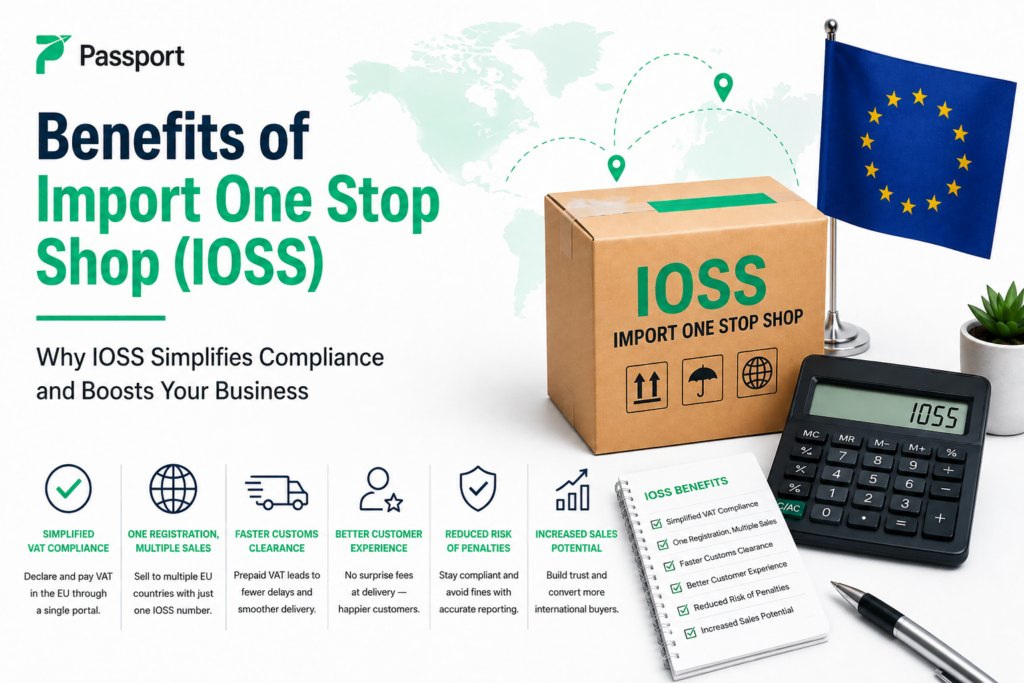
Top 5 Benefits of IOSS
1. Simplified and Faster Customs Clearance
The good news is that clearance through customs should be simplified and faster as import VAT does not have to be applied. The European Commission estimates that using the IOSS can reduce cross-border barriers by up to 95% over other methods.
2. Centralized EU VAT Compliance
IOSS participants can clear customs in any country while other methods must clear customs in the country that the consumer lives in. IOSS allows couriers to ship into one country, clear customs, then deliver anywhere in the EU, reducing risk of transit time delays. This is a major advantage, both from a logistics standpoint of leveraging consolidated air freight rates, as goods can then be moved freely regardless of the end destination of each package.
3. Reduced Delivery Fees and Customer Charges
Other methods that require the courier to collect VAT on the consumer’s behalf will be hit with a customs clearance fee of €5 to €15 per shipment, depending on the country of collection. This is in addition to other courier charges like a disbursement fee, a minimum customs clearance fee, and any other customs brokerage fees that they may tack on. Since customers do not have a negotiated rate with the carrier, they pay the list rates, which often have set minimums. For example, UPS will charge xx in a “disbursement fee” for paying duties and taxes on behalf of the customer.
Unexpected import charges are one of the biggest causes of cart abandonment and delivery dissatisfaction in cross-border ecommerce.
IOSS helps create a more transparent landed cost experience by allowing customers to see VAT charges upfront before completing their purchase.
As EU consumers increasingly expect Delivered Duty Paid (DDP)-style experiences, transparency around VAT and import costs has become increasingly important.
4. Reduced VAT Rate on Certain Goods
Some food, healthcare, personal care, and medical products may be eligible for a reduced VAT rate. However, this rate can only be claimed for goods processed under IOSS — the Member State’s general VAT rate will apply to all other clearance methods.
5. Easier VAT Adjustments for Returns
For goods that are returned and re-exported, sellers who use IOSS can reclaim the VAT paid on that shipment. Since VAT is reported monthly, IOSS participants can simply reverse the charge and save themselves the time, headache, and cash outlay of paying VAT on import and reclaiming it when the product is returned to a non-EU country.
IOSS and the Live 2026 EU Customs Framework
The removal of the €150 duty-free de minimis threshold on July 1st changed the economics of European ecommerce, but it did not make IOSS obsolete. Instead, it changed how IOSS behaves:
- The €3 Flat Duty: Low-value B2C shipments (€150 or less) clearing via IOSS are now automatically assessed a flat €3 customs duty per customs declaration line item.
- Line-Item Grouping Rules: Because this €3 duty applies per declaration line item, items can only be grouped together on a single line if they share the exact same 6-digit HS code, country of origin, and product description. Multi-category orders will generate multiple lines and multiple €3 charges.
- No Preferential Tariffs in IOSS: If your goods are eligible for a zero-duty preferential tariff under a Free Trade Agreement (e.g., items manufactured in the UK shipping directly to the EU), this preference cannot be claimed inside the simplified IOSS clearance flow. To claim an FTA preference, the item must clear outside of IOSS via a standard customs declaration.
- Looking Ahead to November 1, 2026: An additional harmonized €2 customs handling fee per line item is scheduled to take effect later this year. Once live, the combined line-item charge for low-value IOSS imports will total €5.
Brands must now closely analyze their product catalog data, average order values (AOV), and packaging combinations to optimize their checkout under this multi-layered framework.
Next Steps For EU VAT Compliance Through IOSS
We encourage brands to determine what makes the most sense for your business and weigh all your options when it comes to EU VAT compliance.
Your team at Passport is here to absorb this regulatory complexity. Our Seller of Record (SOR) model seamlessly handles your VAT collection, manages IOSS data compliance, and instantly updates checkout logic with our dynamic Landed Cost Calculator so you can keep growing in Europe with zero delivery disruptions.
Contact the Passport Team Today to Safeguard Your European Margins
Frequently Asked Questions
What is IOSS?
Import One-Stop Shop (IOSS) is a centralized EU VAT electronic portal designed to simplify compliance for cross-border distance sales into the European Union. It allows brands to calculate, collect, and remit VAT for all eligible low-value shipments through a single monthly return, eliminating the need to hold local tax registrations in every EU member country.
Does IOSS eliminate customs duties?
No. IOSS simplifies the reporting and collection of import VAT. Following the customs overhaul on July 1, 2026, the €150 duty exemption is gone, meaning shipments valued at €150 or less are now subject to customs duties—specifically a temporary €3 flat duty per declaration line item when utilizing IOSS.
How does the new €3 flat-rate duty interact with IOSS?
When an ecommerce parcel clears customs using an IOSS registration number, the simplified clearance framework automatically applies a flat €3 customs duty to each line item on the declaration. It replaces standard, variable duty percentages but cannot be bypassed unless you clear via standard non-IOSS customs declarations.
Can I claim Free Trade Agreement (preferential) zero duties using IOSS?
No. The simplified IOSS clearance flow does not support the submission of preferential rules-of-origin data. If your goods qualify for reduced or zero duties under an agreement like the UK-EU Trade and Cooperation Agreement and you want to claim that preference, you must clear the shipment outside of the IOSS framework.
Does IOSS apply to all shipments?
No. IOSS is strictly limited to business-to-consumer (B2C) consignments with an intrinsic value of €150 or less. Shipments valued above €150, or items containing excise goods (like alcohol, tobacco, or certain restricted perfumes), are entirely excluded from IOSS processing and follow standard, full customs entries.
What happens if an IOSS shipment contains a “blacklisted” or rejected item?
Certain product types or high-risk HS codes may trigger an “IOSS kick-out” at the border. If a parcel is rejected from the simplified IOSS flow, it is forced into a standard non-IOSS clearance process. This means if the parcel entered through a regional hub (like the Netherlands) but is destined for another country (like Italy), it must be moved under a bonded transit procedure to be cleared and taxed in the destination Member State, resulting in heavy carrier delays and transit fees.
Is IOSS still relevant now that the €150 de minimis threshold has ended?
Absolutely. While IOSS no longer provides a gateway to “duty-free” shipping, it remains the most powerful mechanism for centralized EU logistics. Without an IOSS number, your courier cannot clear cross-border parcels at a centralized entry point; every single order would be subject to localized destination clearance, longer processing backlogs, and steep customer-facing brokerage fees at delivery.