



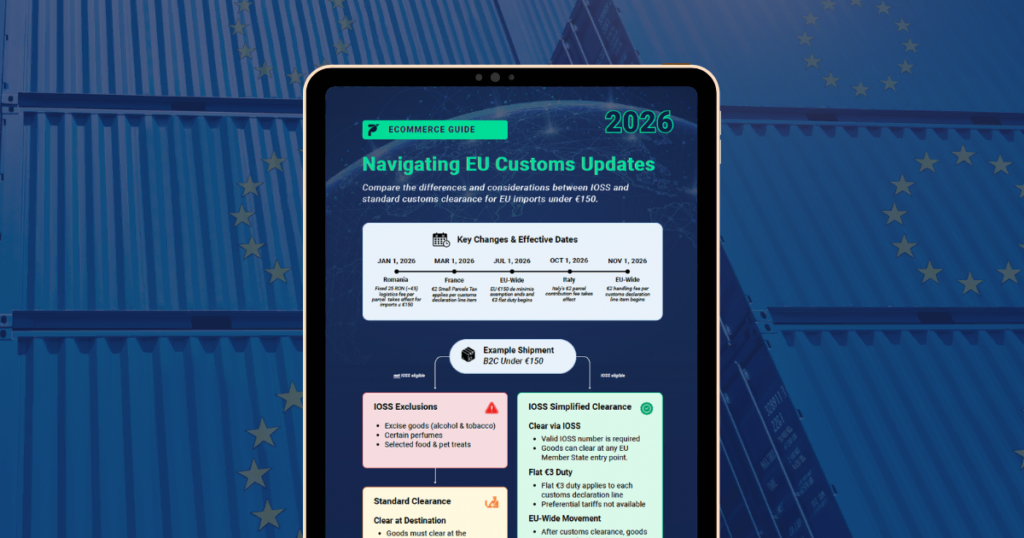
Effective July 1, 2026, the European Union has ended the €150 duty de minimis exemption for low-value imports. For B2C ecommerce shipments with an intrinsic value of €150 or less, merchants need to understand the duty impact.
There are two primary duty outcomes for low-value ecommerce shipments:
- The shipment is charged the €3 flat-rate duty per customs declaration line item, or
- The shipment qualifies for a preferential origin tariff under a valid trade agreement.
However, the route to those outcomes depends on how the shipment clears customs.
If the shipment clears using the Import One-Stop Shop (IOSS) simplified clearance program, the €3 flat-rate duty applies per customs declaration line item. Preferential tariff treatment is not available through IOSS clearance, even if the goods would otherwise qualify under a Free Trade Agreement or other preferential arrangement.
If the shipment does not use IOSS, a preferential tariff may be claimed, but only if the goods qualify under the applicable trade agreement and the importer uses a customs declaration process that supports the preferential-origin claim.
On September 21, 2026, the European Commission confirmed a separate €2 handling fee per customs declaration line item, which should take effect by November 1, 2026. Unlike the €3 flat-rate duty, which covers ecommerce imports valued at €150 or less, the €2 handling fee covers ecommerce imports of any value. For low-value shipments, the two charges add up to €5 per customs declaration line item.
In parallel, several Member States, most notably France, Italy, and Romania, have moved ahead with national clearance or handling fees. These charges are legally distinct from VAT and customs duty, creating a multi-layered tax environment for ecommerce imports.
This guide outlines the latest developments, what they mean for ecommerce merchants, and how Passport is preparing to support brands through the transition.
What Is Changing
End of duty-free treatment for low-value goods
Under previous EU rules, goods with an intrinsic value of €150 or less were exempt from customs duty, even though VAT is payable. The recent reform removes this exemption. As of July 1, 2026, low-value goods are no longer exempt from customs duty solely because their intrinsic value is EUR 150 or less. Depending on the declaration route and eligibility for preferential treatment, a shipment may be charged the temporary EUR 3 duty or a preferential/normal tariff rate.
For B2C ecommerce shipments with an intrinsic value of €150 or less, merchants should generally plan around two possible duty outcomes:
- The shipment is charged the €3 flat duty per customs declaration line item, or
- The shipment qualifies for a preferential origin tariff.
The key question is also how the shipment is cleared.
If the shipment clears under IOSS, the simplified IOSS clearance flow does not support preferential tariff treatment. In that case, the FTA preference is effectively unavailable through that flow, and the €3 flat-rate duty applies per customs declaration line item.
If the shipment does not clear under IOSS, the merchant may be able to claim a preferential tariff, but only if the goods qualify under the applicable preferential rules of origin and the required declaration process is used.
For example, goods with UK country of origin shipped directly from the UK to the EU may qualify for preferential treatment under the UK-EU Trade and Cooperation Agreement, provided the goods meet the applicable rules of origin and the required documentation is available.
However, that preference must be claimed through a customs declaration process that supports preferential-origin data. If the goods are cleared using IOSS, the €3 flat-rate duty applies instead.
Direct shipment also matters. A product manufactured in the UK but shipped from Canada to the EU would generally not qualify for UK-EU preferential treatment, because the goods are not shipping directly from the originating country under that agreement.
Interim EU customs duty on small parcels (from July 2026)
The EU is building a centralized customs platform called the EU Customs Data Hub, which will give traders a single EU-wide system for submitting, managing, and reviewing customs data. Because the EU doesn’t expect the Data Hub to be fully operational until around 2028, it introduced an EU-wide customs duty mechanism that applies until the permanent system is ready
The EU introduced a temporary €3 flat-rate duty per customs declaration line item for ecommerce imports. This interim duty bridges the gap until the EU Customs Data Hub goes live. On September 21, 2026, the European Commission also confirmed a separate €2 customs handling fee per customs declaration line item, which should take effect by November 1, 2026. For low-value shipments, the two charges add up to €5 per customs declaration line item.
For merchants shipping multi-item or multi-category orders, this means landed costs may increasingly depend on how products are grouped for customs clearance.
Customs declaration line item grouping rules
Because duties and handling fees apply per customs declaration line item, how products are grouped within a shipment can directly impact landed costs.
As customs data requirements expand, accurate product catalog data and standardized product identifiers will become increasingly important for compliant customs processing.
Phase 1 — As of July 1, 2026
Products may be grouped into the same customs declaration line item only if they share:
- The same HS6 classification
- The same country of origin
- The same product description
Product identifier requirements
As part of the expanded customs data requirements, merchants should prepare to provide more detailed product identifiers for EU ecommerce imports. There are three distinct identifiers involved
As of July 1, 2026, product identifiers are optional but recommended. Merchants may provide these identifiers to support more complete customs data.
Beginning November 1, 2026, all three become mandatory for applicable shipments:
- Merchant Product Identifier (M-PID) — the seller’s own SKU or listing ID.
- Non-Standardised Manufacturer Product Identifier (NS-PID) — the supplier or factory’s internal part number. This one is easy to miss because it isn’t a barcode and has no fixed format, but it’s required alongside the M-PID, not optional.
- Standardised Manufacturer Product Identifier (S-PID) — a recognized barcode standard (GTIN, EAN, UPC, or ISBN), required only where one exists.
For a full breakdown of each identifier, the TARIC codes used to declare them, and what to do when a product has no barcode, see our complete guide to EU Product Identifiers.
Example: How Multi-Item Orders Could Be Charged
A shipment containing:
- Two T-shirts
- One leather belt
may generate multiple customs declaration line items if the products fall under different HS6 classifications or grouping rules.
As a result, the shipment could incur multiple €3 duties and multiple €2 customs handling fees, increasing total landed costs compared to single-category orders.
Importantly, these rules are expected to apply based on the shipment’s customs clearance date rather than the original order date. Orders placed before July 1, 2026 may still become subject to the new framework if they clear customs after implementation begins.
Preferential Tariffs and Rules of Origin
Preferential tariffs allow eligible goods to receive reduced or zero-duty treatment under a trade agreement between the country of origin and the EU. These agreements can include Free Trade Agreements, customs unions, economic partnership agreements, and autonomous preference schemes.
To qualify, the goods must meet the preferential rules of origin in the applicable agreement. This usually means the goods must be sufficiently produced or processed in the originating country, shipped under the required conditions, and supported by valid origin documentation.
For low-value ecommerce shipments, preferential tariffs may provide a way to avoid or reduce the €3 flat-rate duty. However, the preference must be validly claimed.
National clearance and handling fees (parallel developments)
Beyond EU-level duties, several Member States have implemented independent fees to recover administrative and inspection costs. These charges are legally distinct from customs duty and VAT; notably, they may still apply even if VAT has been prepaid via the Import One-Stop Shop (IOSS).
Confirmed national measures include:
*Update: Italy’s 22 June 2026 Council of Ministers decision (Decree-Law No. 107) postponed the €2 parcel contribution to October 1, 2026. Law No. 152 of 7 August 2026, published 20 August and effective 21 August, then confirmed that date.
France and Italy are clearance-based fee environments. These fees are only triggered if the goods are physically customs-cleared in that specific country. For example, a parcel destined for a French consumer but cleared in the Netherlands will not attract the French Small Parcels Tax.
Romania is destination-based. The Romanian logistics fee applies to ecommerce goods delivered to Romanian consumers, regardless of the EU entry point. This fee is collected from the shipper for both DDU vs. DDP shipments.
In the past few days, the postal operators of Germany and Denmark have stated that they will not accept DDU shipments after July 1, 2026. Other posts may also consider a similar position. In addition, some EU countries have indicated that they will no longer clear DDU shipments where an IOSS number is associated. While IOSS technically remains valid for postal shipments, it is largely unavailable in practice due to the uncertainty around who will account for the flat rate customs charge. Because of this, expect postal shipments where an IOSS number is included in the data to be rejected or refused entry.
Where possible, merchants should consider transitioning EU shipments to a Delivered Duty Paid (DDP) model. A DDP approach gives brands greater control over duties, VAT, clearance fees, and the consumer delivery experience, helping reduce surprise charges at delivery and lowering the risk of abandoned or undeliverable parcels.
The new IOSS and non-IOSS distinction makes this more operationally complex. If a shipment uses IOSS, it may be able to clear in any EU Member State. If the shipment does not use IOSS, or if it is kicked out of IOSS because the goods are excluded or blacklisted, it may need to be cleared in the consumer’s destination Member State.
IOSS generally cannot be used for goods subject to excise duties, such as alcohol, tobacco, and certain perfumes, select food & beverage products and pet treats. Additional restricted goods may also be rejected from IOSS processing depending on the HS code, carrier rules, or destination-country customs requirements. These rejected categories are often referred to as IOSS blacklisted items.
That requirement can create serious operational constraints. Not every carrier has the ability to move non-IOSS ecommerce parcels under customs transit to every EU Member State. Merchants that choose not to use IOSS, or whose goods are prohibited from IOSS clearance, may face routing limitations, customs delays, additional costs, or failed delivery attempts.
IOSS, Destination Clearance, and Transit Risk
The hardest operational change is not only the duty rate. It is where the shipment clears customs and who accounts for the duties.
For low-value B2C ecommerce shipments, IOSS remains a critical clearance tool. If a valid IOSS number is used, goods can generally clear customs in any EU Member State. This means a shipment entering the EU through a major hub such as the Netherlands may clear customs there, even if the final consumer is in Italy, France, Spain, or another Member State.
If IOSS is not used, or if the goods are not eligible for IOSS because they are excluded, the shipment must generally clear customs in the Member State of the consumer who made the purchase.
For example, if goods arrive in the Netherlands but were ordered by a consumer in Italy, the shipment cannot clear customs in the Netherlands. It may need to move under a transit procedure, essentially a bonded movement, from the Netherlands to Italy and clear customs there.
This creates a major operational dependency on carrier/capability. For merchants, the practical takeaway is that IOSS is not just a VAT simplification mechanism. It can determine whether a low-value shipment can clear efficiently at the EU entry point or must move under customs transit to the destination country before clearance.
Who Pays the €3 Flat Duty?
The party that accounts for the €3 flat duty depends on the shipping model and carrier type.
For express and courier shipments, the carrier or operator will typically pay the €3 flat duty at clearance and charge it back to the seller, shipper, or merchant, depending on the commercial arrangement.
Postal shipments are more complex. Postal shipments are often structured as DDU or DAP, meaning the shipment may be at the mercy of the destination post for customs clearance. In some cases, the destination post may reject the shipment or refuse entry if it cannot be cleared under the required process.
If the local post does clear the shipment, it may collect the flat-rate duty from the consumer, along with VAT and a clearance fee. In other cases, the post may charge the shipper if that arrangement is supported and enabled.
This can create a materially different customer experience. Express and courier shipments may allow sellers to preserve a more controlled Delivered Duty Paid experience. Postal shipments may expose consumers to duties, VAT, and clearance fees at delivery, increasing the risk of failed delivery, abandoned parcels, or negative customer experience.
What the EU May Treat as Avoidance
The new rules do not only introduce a €3 duty. They also narrow the room for structures designed primarily to avoid that duty.
Merchants should be especially cautious with strategies that attempt to change the form of the transaction while leaving the commercial reality unchanged. In practice, customs authorities may look beyond the paperwork to determine whether a low-value B2C sale occurred before import, whether goods were artificially grouped, or whether a warehouse or B2B structure is being used mainly to sidestep the temporary duty.
Areas that deserve particular review include:
- Moving volume away from IOSS solely to avoid the flat-rate duty
- Grouping unrelated SKUs onto one customs declaration line
- Treating marketing bundles as customs “sets” when they do not qualify
- Consolidating multiple consumer orders into a single B2B-style import
- Delaying the formal sale while accepting payment, authorization, or a commitment to pay before import
- Using customs warehousing as a cross-dock for orders already sold to EU consumers
There are still compliant levers available, including accurate classification, defensible declaration-line grouping, valid preferential tariff treatment, local fulfillment, and basket-building strategies that move orders above the €150 low-value threshold. But the key is that the structure has to reflect the commercial reality of the transaction.
For a deeper look at which post-July 1 strategies may be treated as avoidance — and which operational levers remain available — read our companion guide The EU’s €3 Flat Duty Is Live. Here’s What Counts as Avoidance — and What Doesn’t.
IOSS Blacklisted Items and Kick-Outs
In addition to duty calculation and product grouping, merchants should prepare for another operational risk: IOSS blacklisted items.
Certain HS codes or product types may be rejected by customs authorities for IOSS processing. These items are sometimes referred to operationally as IOSS blacklisted items because they are prohibited from utilizing the IOSS simplified clearance process
Merchants should work with their logistics and compliance partners to identify affected HS codes and scrub shipments before export. Where possible, blacklisted items should be isolated from IOSS-eligible items so they do not disrupt the clearance of an entire parcel or order.
This matters because an IOSS kick-out can force the shipment out of the simplified import flow and into the more complex non-IOSS clearance process. If the parcel entered the EU through a hub country but must ultimately be cleared in the consignee’s destination Member State, the shipment may need to move in-bond under customs transit.
Failing to identify and isolate blacklisted items could therefore create downstream operational problems, including delayed customs clearance, forced rerouting, additional carrier intervention, destination-country clearance failures, or undeliverable packages.
For merchants, the operational priority is clear: product catalog data should be reviewed not only for HS6, country of origin, SKU, and product identifier accuracy, but also for IOSS eligibility. Items that are not IOSS-compatible should be flagged before they are mixed into otherwise eligible low-value EU shipments.
Latest Country-Level Updates (Confirmed & Upcoming)
🇷🇴 ROMANIA | Logistics Tax
Effective January 1, 2026 — Fixed logistics tax of 25 lei (~€5) per parcel for non-EU imports ≤ €150.
🇫🇷 FRANCE | Small Parcels Tax (SPT)
Effective March 1, 2026 — €2 fee per customs declaration line item or imports under €150.
🇮🇹 ITALY | Parcel Fee Confirmed €2 parcel contribution confirmed for October 1, 2026
🇪🇺 EU | De Minimis Phase-Out / Handling Fee Effective July 1, 2026 — The EU removed the €150 duty-free threshold. A temporary €3 flat-rate duty per customs declaration line item now applies to ecommerce imports valued at €150 or less, unless the importer claims a valid preferential tariff through the appropriate declaration process.
Confirmed September 21, 2026 — The European Commission confirmed a €2 handling fee per customs declaration line item on ecommerce imports of any value, which should take effect by November 1, 2026. For low-value shipments, the two charges add up to €5 per customs declaration line item.
This page is updated as EU customs rules are finalized, implemented, or revised.
Passport’s Preparations: What Brands and Partners Can Expect
Passport closely tracks these changes and manages them on behalf of our merchants and partners.
Landed Cost Calculator
Passport’s landed cost calculator automatically adapts to new EU duty and handling fee requirements as they take effect, helping brands accurately calculate import costs, VAT, and applicable parcel fees at checkout.
As customs charges increasingly shift to customs declaration line item-level assessment, Passport’s infrastructure will continue updating dynamically to support compliant and accurate landed cost calculations across different shipment types and clearance methods.
Passport Seller-of-Record® (SOR)
Passport’s SOR service will continue to account for VAT compliance, ensuring our merchants remain unaffected by these changes.
Passport Global In-Country Enablement
Passport In-Country Enablement is an end-to-end solution for forward-stocking inventory in the EU. Brands can declare duties on inventory cost (COGS) instead of the retail price at the time of sale—reducing overall duty exposure and improving landed cost predictability. For brands shipping high-frequency, low-AOV orders, this can materially improve unit economics.
What This Means for You
With the €3 flat-rate duty live, national fees in place in France and Romania, Italy’s fee starting October 1, and the €2 EU handling fee confirmed, EU customs reform has moved from proposal to operational reality
Brands should also prepare for the operational impact of these changes. Under current guidance, customs authorities generally won’t refund the €3 flat-rate duty or the €2 customs handling fee on returned or undeliverable shipments, which can raise returns and reverse-logistics costs for ecommerce orders.
Merchants should also review their IOSS strategy. IOSS can materially affect where goods clear customs and whether a shipment can avoid destination-country transit requirements. However, IOSS does not support preferential tariff treatment through the IOSS clearance flow.
Merchants should also review whether their goods may qualify for preferential tariff treatment. Preferential origin claims require accurate country-of-origin data, valid origin documentation, and the appropriate customs declaration process.
Product catalogs should be reviewed for HS classification accuracy, country of origin, product descriptions, merchant product identifiers, standardized manufacturer identifiers, preferential origin eligibility, and IOSS eligibility.
At the same time, EU customs authorities will require more detailed product-level information starting November 1, 2026: a merchant product identifier such as a SKU, the manufacturer’s own part number, and a standardized product identifier such as a GTIN, EAN, or UPC where one exists. For many brands, data quality and product catalog accuracy now directly affect how smoothly shipments clear customs.
Passport built its infrastructure and compliance programs to support these changes, so merchants, fulfillment partners, and consumers get a smooth transition with no disruption at checkout or customs clearanc
If you’d like to discuss how Passport Global’s In-Country Enablement solution can help your brand stay ahead of these changes.
Sources & Regulatory References
- European Commission — E-commerce: €150 customs duty exemption threshold to be removed as of 2026.
- Customs Guidance on EUR 3 Customs Duty
- Council of the European Union — Final approval of new customs duty rules for small parcels.
- Commission Delegated Regulation C(2026) 6694 establishing the amount of the Union handling fee: Register of Commission Documents · Council of the EU Document 13480/26
- EUR-Lex — COM(2023)258, EU Customs Reform proposal.
- EUR-Lex — COM(2023)259, simplified tariff treatment and removal of customs duty relief threshold.
- EUR-Lex — (EU) 2026/382:Council Regulation (EU)
- European Commission Press Release (Historic Agreement):
- Commission Delegated Regulation C(2026) 2760: Register of Commission Documents
- Council of the EU Document
- European Commission Q&A on the EU Customs Reform
- European Commission — VAT One Stop Shop / Import One Stop Shop guidance.
- French Customs — Taxe sur les petits colis implementation guidance.
- Italian Ministry of Economy and Finance — small-consignment administrative contribution.
- Dutch Customs — Handling fee for e-commerce shipments.
- Romania — FAN Courier guidance on the 25 RON logistics fee.
- European Commission — Preferential rules of origin.
- European Commission — EU-UK Trade and Cooperation Agreement.
- European Commission — VAT One Stop Shop / Import One Stop Shop guidance.

Authored by Thomas Taggart
Head of Global Trade | Passport
Thomas Taggart is a cross-border commerce leader with more than 20 years of experience in international shipping and regulatory affairs. As the Head of Global Trade, Thomas helps ecommerce brands go global by simplifying international trade, tax, and product compliance issues. Prior to Passport, he brought international shipping solutions to market through multiple roles in UPS’s product development organization.
Frequently Asked Questions
What happens when a non-IOSS shipment has to move under transit?
A non-IOSS shipment can still move duty-unpaid from its first EU point of entry to the consumer’s destination country under a T1 transit procedure. However, once the €150 duty exemption is removed, these parcels may no longer qualify for simplified bulk-release processing at major entry hubs. Instead, the shipment may need an electronic transit MRN and a valid financial guarantee covering the duties that may become due, including the €3 ecommerce duty per customs declaration line item. The goods would then be formally checked and cleared at the final Office of Destination. For merchants, this means non-IOSS shipments may create more carrier complexity, especially if the carrier cannot support transit movements, MRNs, and financial guarantees across all EU destination countries.
What are preferential rules of origin?
Preferential rules of origin determine whether goods qualify for reduced or zero-duty treatment under a trade agreement between the country of origin and the EU. To qualify, the goods must meet the specific origin rules in the applicable agreement. This usually means the goods must be sufficiently produced or processed in the originating country and must be shipped with the required origin documentation. For example, goods with UK country of origin shipped directly from the UK to the EU may qualify for preferential treatment under the UK-EU trade agreement if they meet the relevant rules of origin.If the goods do not qualify for preferential origin treatment, the €3 flat duty per customs declaration line item may apply.
Which commodities cannot clear via IOSS?
IOSS generally cannot be used for goods subject to excise duties, such as alcohol, tobacco, and certain energy products. IOSS is also limited to B2C consignments with an intrinsic value of €150 or less.
In practice, some customs authorities and logistics providers may reject additional restricted or controlled goods from IOSS processing based on HS code, product type, or destination-country requirements. These are often referred to as IOSS blacklisted items.
Merchants should review their product catalog for IOSS eligibility before shipment. If a shipment is kicked out of IOSS, it may need to clear customs in the consumer’s destination Member State and could require customs transit from the first EU point of entry.
How do I claim a preferential tariff?
To claim a preferential tariff, the importer must be able to show that the goods qualify under the relevant trade agreement. This typically requires three things: the correct country of origin, compliance with the agreement’s rules of origin, and valid origin documentation.
For ecommerce merchants, this means product catalog data should accurately identify country of origin, and shipment documentation should include the required proof of origin or origin statement. The goods may also need to ship directly from the originating country to the EU without passing through another country in a way that breaks preferential treatment.
If the preferential claim is valid, the shipment may qualify for reduced or zero-duty treatment instead of the €3 flat duty. If the claim is missing, invalid, or unsupported, the €3 flat duty may apply.
How will bundles or sets be handled?
Bundles and sets can be tricky because what appears as a single product at checkout may not always be treated as a single item for customs purposes. In some cases, a bundle may be declared on one customs declaration line, but many mixed-product bundles must be broken out and declared by component.
Whether a bundle can be declared as one item depends on the specific products included and the applicable customs classification rules. If the items in the bundle have different HS6 classifications, countries of origin, or product descriptions, they may need to be declared separately.
For example, a bundle containing a t-shirt, a leather belt, and a cosmetic item may generate multiple customs declaration line items because each product may fall under a different HS6 code. Because the €3 flat duty and the €2 handling fee both apply per customs declaration line item, bundles with mixed product types can trigger multiple charges.
Merchants should review bundles and kits carefully to ensure each component has accurate HS classification, country of origin, product description, and product identifier data. This will help support accurate landed cost calculations and reduce the risk of customs delays.
Does using IOSS affect where my parcel can clear customs?
Yes. For low-value shipments valued at €150 or less, using a valid IOSS number can help support simplified import processing. If a merchant does not use IOSS, the shipment may need to be cleared in the destination Member State rather than the first EU country of entry. This can require the parcel to move under customs transit, or in-bond, from the EU entry hub to the consignee’s country.
What happens if a non-IOSS parcel enters the EU through one country but is destined for another EU country?
If the parcel is not eligible to clear at the point of entry, it may need to move in-bond to the destination Member State before final customs clearance. This can create operational challenges because not all carriers support customs transit movement for ecommerce parcels to every EU country. Merchants may face delays, routing bottlenecks, or undeliverable packages.
Is there any way to avoid the €3 flat-rate duty on a non-IOSS shipment?
Potentially, yes. A non-IOSS shipment may be able to avoid the €3 flat-rate duty if the importer can make a valid preferential tariff claim. For example, goods with UK country of origin shipped from the UK to the EU may qualify for preferential treatment under the applicable free trade agreement, provided the goods meet the relevant rules of origin and the required documentation is available.
What are IOSS blacklisted items?
IOSS blacklisted items are products or HS codes that customs authorities may reject from IOSS processing. If a shipment contains these items, it may be kicked out of the simplified IOSS flow and forced into a non-IOSS clearance process. Merchants should identify and isolate affected items before shipment to avoid disrupting otherwise eligible parcels.
Why do IOSS kick-outs matter under the new EU customs rules?
An IOSS kick-out can force a shipment into destination-country clearance procedures. If the parcel entered the EU through a hub country, it may need to move in-bond to the consignee’s Member State before it can clear customs. Because many parcel carriers do not support this process across all EU destinations, kick-outs can create delays, rerouting issues, or undeliverable shipments.
What are the new EU ecommerce import fees starting in 2026?
Since July 1, 2026, the EU has charged a temporary €3 flat-rate duty per customs declaration line item on ecommerce imports with an intrinsic value of €150 or less, unless a valid preferential tariff applies. On September 21, 2026, the European Commission also confirmed a separate €2 customs handling fee per customs declaration line item, which should take effect by November 1, 2026. Unlike the €3 flat-rate duty, the €2 handling fee covers ecommerce imports of any value. For low-value shipments, the two charges add up to €5 per customs declaration line item.
Will EU customs changes increase costs for low-value e-commerce orders?
Yes. The EU ended the €150 duty de minimis exemption on July 1, 2026, so low-value imports now pay the €3 flat-rate duty per customs declaration line item unless a valid preferential tariff applies. The €2 handling fee per customs declaration line item, which should take effect by November 1, 2026, adds to that cost.
In addition, several EU Member States, including Romania, France, and Italy, have introduced national clearance or handling fees. These fees are separate from customs duty and VAT and can increase landed costs on low-value orders.
Do national clearance fees apply even if VAT is prepaid through IOSS?
Yes. National clearance and handling fees are legally distinct from VAT and customs duty and may apply even when VAT is prepaid via IOSS.
This means VAT prepayment alone does not necessarily eliminate additional import-related charges.
Will these EU customs changes affect checkout or delivery experiences?
Not when managed through Passport. Passport’s Seller-of-Record® model and in-country enablement infrastructure are designed to absorb regulatory complexity and manage duties, VAT, and clearance fees behind the scenes—helping brands offer a Delivered Duty Paid (DDP) experience with transparent landed costs at checkout. This helps avoid the surprise duties and fees consumers often face with Delivered Duty Unpaid (DDU) shipping, where charges are collected at delivery and can negatively impact the customer experience.
How do I know if a fee is charged per parcel or per product?
It depends on the charge:
- Per parcel (flat fee): Romania and Italy apply a single fee to the entire shipment, regardless of contents.
- Per customs declaration line item (stackable): The EU’s €3 flat-rate duty and €2 handling fee, and France’s Small Parcels Tax, apply per customs declaration line item. Products share a line only if they have the same HS6 classification, country of origin, and product description, so a parcel with several product types can trigger several charges.
How is the handling or customs fee calculated—per parcel or per product?
It varies by country:
- Romania: Fee is applied per parcel, regardless of the number or type of items included.
- European Union (As of July 2026): Fees are applied per customs declaration line, not per parcel. This means each distinct product classification is charged separately. For example, if a shipment contains items that fall under two different HS6 codes, the fee will be applied twice — once for each classification.
What is a merchant product identifier?
A merchant product identifier is an internal product reference used within a seller’s inventory or ecommerce management system. The most common example is a Stock Keeping Unit (SKU).
Merchant product identifiers are created and managed by the seller and do not need to follow any global formatting standard. Businesses often use SKUs to track inventory, manage fulfillment, organize catalogs, and reconcile orders across systems.
What is a standardized manufacturer product identifier?
A standardized manufacturer product identifier is a globally recognized product code used to uniquely identify a product across retailers, marketplaces, carriers, and supply chain systems.
Common examples include:
- GTIN (Global Trade Item Number)
- UPC (Universal Product Code)
- EAN (European Article Number)
- ISBN (International Standard Book Number)
- IMEI (International Mobile Equipment Identity)
Unlike merchant SKUs, these identifiers follow international standards and are often assigned by manufacturers or authorized organizations.
What is the difference between a SKU and a UPC?
A SKU is an internal product identifier created by the merchant for inventory management purposes. A UPC is a globally standardized barcode used to identify products across retailers and supply chains.
SKUs are unique to each business and can be formatted however the merchant chooses, while UPCs and other GTIN-based identifiers follow standardized global rules.
Are merchant product identifiers required?
Yes. Merchant product identifiers such as SKUs are generally required because they help sellers, marketplaces, and logistics providers identify and manage products within operational systems.
Are GTINs, UPCs, or EANs always required?
No. Standardized manufacturer identifiers are typically only required if the product already has one assigned.
If a product does not have a GTIN, UPC, EAN, or similar global identifier, merchants may still be able to sell or ship the item using only their internal merchant product identifier.
Why are product identifiers important for ecommerce and international shipping?
Product identifiers help improve inventory accuracy, order management, customs documentation, marketplace listings, and cross-border logistics operations.
For international ecommerce brands, accurate product identifiers can help streamline fulfillment workflows, reduce shipping errors, and improve product visibility across marketplaces and carrier systems.