


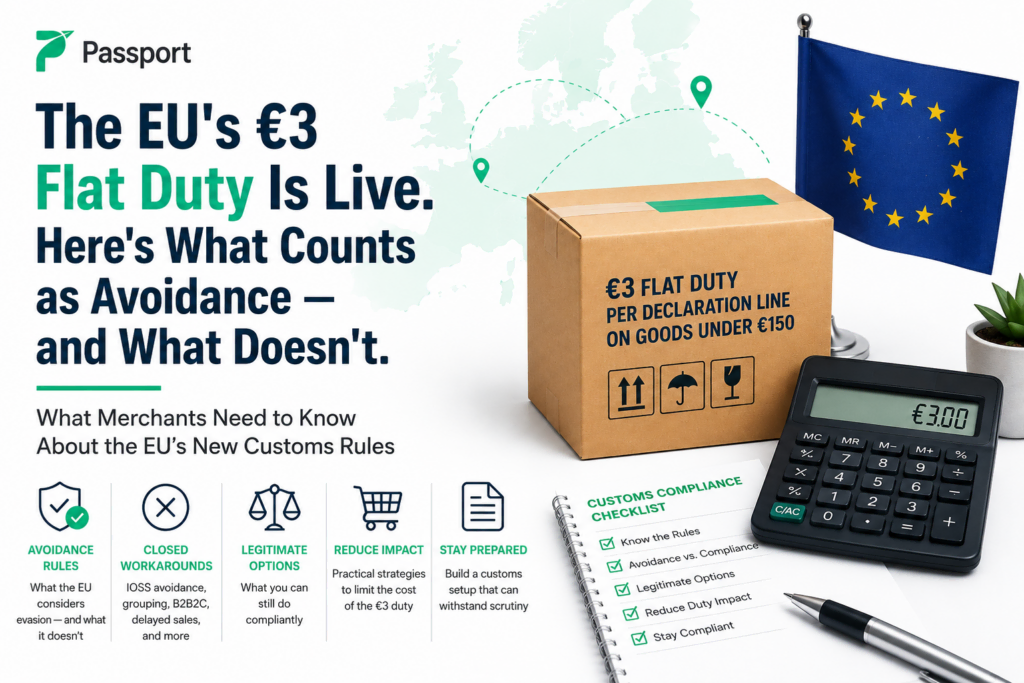
The EU’s July 1st e-commerce customs changes are officially in effect. Duty de minimis is gone, and a temporary €3 customs duty now applies to each customs declaration line for low-value consignments, meaning goods valued under €150.
“Temporary” does not mean short-lived. The €3 rate is expected to remain in place until 2028, when the EU’s broader customs reform is scheduled to take effect.
The EU Council approved the flat rate duty in November 2025, but the details arrived gradually with implementing regulations trickling in over the following months. In fact, the EU updated its FAQ the evening before the rules went live.
From the beginning, the EU recognized this new duty was imperfect and that those impacted would look for ways around it. To get ahead of it, the EU wrote specific “anti-abuse” rules into the regulations and created mandatory monitoring and review structures.
Once you understand what the EU treats as avoidance, it becomes easier to see which options are still on the table and how to limit the impact of the flat-rate duty without crossing a compliance line.
Here are the top workarounds the EU will be looking for:
Skipping IOSS Entirely
The flat-rate duty can make IOSS less attractive than it used to be.
When IOSS launched, the EU offered merchants a meaningful incentive: centralized clearance. Also called consolidated or single-point clearance, IOSS allows eligible goods to clear customs in any EU member state.
Without IOSS, goods entering through a logistics hub like the Netherlands are generally expected to move under a transit procedure — similar to a bonded move — to the consumer’s destination country and clear customs there. That requirement has existed on paper since 2021, but it was not consistently enforced. That is changing.
For products with low standard duty rates, such as cosmetics, electronics, and toys, standard clearance may look more attractive. Instead of paying the flat €3 duty per declaration line, merchants may pay the product’s standard duty rate. But that choice comes with a major tradeoff: standard clearance means clearing goods in the consumer’s own country, which removes the centralized clearance benefit that made IOSS operationally valuable in the first place.
There is only one clearly legitimate reason to opt out of IOSS: your goods qualify for a preferential tariff rate, which we cover below.
Outside of that, merchants should be cautious. The European Commission has an explicit mandate to monitor this kind of trade diversion, and it has the authority to extend the €3 duty to non-IOSS flows if it sees merchants shifting volume at scale to avoid the flat-rate duty.
Consolidating Everything Onto One Customs Line
Because the flat duty is charged per customs declaration line, fewer lines means less duty. That is why the EU has been so specific about how goods can — and cannot — be grouped.
Customs brokers typically group items with the same HS code onto a single declaration line. Historically, that streamlined entry preparation and reduced clearance costs. IOSS clearance only required a six-digit HS code, and country of origin was optional, so many products could be grouped together.
The new rules narrow that flexibility. Items can only be grouped on the same line when the HS code, product description, and country of origin (where declared) are identical.
That also closes off a common workaround: bundling. Merchants often sell multiple products together and present them as one item at checkout. But customs rules only allow goods to be treated as a “set” in very specific circumstances. A bundle that works for marketing almost never qualifies as a set for customs purposes.
Structuring Around B2B2C
Consolidating multiple consumer orders into a single customs entry under one importer should make it a B2B entry, placing it outside the scope of the new flat-rate duty.
That setup was questionable even before July 1, especially when it was used to claim a lowe customs value and reduce duty. The European Commission has now closed it off for distance sales.
In its June 2026 guidance, the Commission pointed to the CJEU’s Har Vaessen decision — a Dutch customs case that, ironically, originally helped support de minimis treatment. In that case, the court allowed individual orders to benefit from de minimis when they had already been sold to end consumers before import, even if those orders were bundled into a single customs entry.
The Commission’s new guidance effectively turns that logic around. When individual consumer orders are imported in bulk, customs must treat each consignment separately and apply the €3 duty per relevant line. Operators cannot avoid the distance-sale rules simply by consolidating multiple orders into one entry.
Delaying the Sale Until After Import
Some providers considered changing their sale terms so the transaction would not technically close until after customs clearance. The goal was to claim that no sale to the consumer had actually occurred prior to import so that the flat-rate duty would not apply.
The EU has closed that route as well.
If a customer’s payment, payment authorization or commitment to pay is accepted while the goods are still outside the EU, the transaction is treated as an import distance sale, regardless of how the shipment is described at import.
In other words, the €3 duty analysis follows the underlying B2C transaction — not the paperwork around it.
The Commission’s FAQs make that clear. Customs authorities can disregard arrangements designed to hide a consumer sale by artificially changing contracts, grouping goods, or combining orders to avoid the temporary duty.
Using Customs Warehousing as a Cross-Dock
One clear goal of the new rules is to push more importers toward EU customs warehousing. In a customs warehouse, merchants can hold unsold inventory in the EU and defer duties until the goods are released for fulfillment.
That raised an obvious question: could merchants import bulk inventory under a nondescript label, route it through a customs warehouse, and relabel it there for final delivery to the consumer?
The latest guidance takes a firm stance: if the warehouse is effectively being used to stage goods for final consumer distribution, and the consumer sale occurred before the goods were released into free circulation, the warehouse structure does not prevent the shipment from being classified as a distance sale subject to the flat-rate duty.
Claiming Preferential Tariffs
Preferential origin is one legitimate path that remains open — but only for goods that actually qualify.
Under preferential rules of origin, goods may receive reduced or zero-duty treatment if they qualify under a trade agreement between their country of origin and the EU. That usually means the goods were sufficiently produced or processed in the originating country and are supported by the required origin documentation.
For example, goods of UK origin shipped directly from the UK to the EU may qualify under the UK-EU trade agreement if they meet the applicable rules of origin.
If they do not, the flat €3 duty applies in full to each customs declaration line.
So, What Can You Do?
Cross-border shipping to the EU isn’t dead — it’s just more demanding.
You need more than a carrier. You need an enablement partner who can get you through these changes compliantly. That starts with the fundamentals:
- Accurate HS classification and compliant customs descriptions
- Defensible customs item grouping
- Defined customs clearance rules
- Preferential tariff rates applied where applicable and defensible
- Landed cost calculations that reflect the new customs reality, or are built into product pricing
- Localization that makes the order feel domestic to the EU consumer
- A returns strategy that accounts for the fact that the €3 duty is non-refundable
And it extends to the practical:
Build bigger baskets. The flat-rate duty only applies to orders valued at €150 or less. Encourage consumers to cross that threshold with free shipping, a free item, or bundles built specifically to land above €150.
Price in local currency. This removes the uncertainty of currency fluctuations pushing orders over or under the threshold — and as a simple localization step, it also helps conversion.
Consider local fulfillment. In-country fulfillment remains a fully compliant option and a strong consideration for many merchants. The benefits of moving unsold inventory into the EU go well beyond duty optimization.
Questions about how the EU’s July 1 changes affect your shipments? Reach out to our team to talk through your EU strategy.

Authored by Thomas Taggart
Head of Global Trade | Passport
Thomas Taggart is a cross-border commerce leader with more than 20 years of experience in international shipping and regulatory affairs. As the Head of Global Trade, Thomas helps ecommerce brands go global by simplifying international trade, tax, and product compliance issues. Prior to Passport, he brought international shipping solutions to market through multiple roles in UPS’s product development organization.
Frequently Asked Questions
What changed for low-value e-commerce shipments to the EU?
As of July 1, the EU has removed duty de minimis for low-value consignments. A temporary €3 customs duty now applies to each customs declaration line for goods valued under €150.
How long will the €3 flat duty apply?
The €3 duty is temporary, but it is not expected to disappear quickly. It is expected to remain in place until 2028, when the EU’s broader customs reform is scheduled to take effect.
Does the €3 duty apply per shipment or per item?
The duty applies per customs declaration line. That means how items are classified and grouped on a customs declaration matters. Fewer compliant declaration lines can reduce duty exposure, but goods can only be grouped when the HS code, product description, and country of origin, where declared, are identical.
Can merchants avoid the €3 duty by skipping IOSS?
Not as a general strategy. Standard clearance may apply the product’s normal duty rate instead of the flat €3 duty, but it also means goods must clear customs in the consumer’s destination country. That eliminates the centralized clearance benefit that made IOSS valuable.
The one clearly legitimate reason to opt out of IOSS is when goods qualify for a preferential tariff rate.
What happens if merchants shift volume away from IOSS to avoid the flat duty?
Merchants should be cautious. The European Commission has an explicit mandate to monitor trade diversion and can extend the €3 duty to non-IOSS flows if it sees merchants moving volume at scale to avoid the flat-rate duty.
Can multiple products be grouped onto one customs line?
Only in limited circumstances. Under the new rules, items can be grouped on the same customs line only when the HS code, product description, and country of origin, where declared, are identical.
Do product bundles count as one item for customs purposes?
Usually, no. A bundle that works for merchandising or checkout purposes does not automatically qualify as a customs “set.” Customs rules only allow goods to be treated as a set in specific circumstances. Most marketing bundles still need to be declared as separate items.
Can merchants consolidate multiple consumer orders into one B2B customs entry?
No. The Commission’s latest guidance makes clear that individual consumer orders imported in bulk must still be treated separately for purposes of the flat-rate duty. Consolidating multiple orders into one entry cannot be used to sidestep the distance-sale rules.
Can merchants delay the legal sale until after customs clearance?
Not if the commercial reality shows a consumer sale already happened. If the merchant accepts payment, payment authorization, or a commitment to pay while the goods are still outside the EU, the transaction can be treated as an import distance sale regardless of how the shipment is labeled at import.
Can customs warehousing help reduce duty exposure?
Yes, but only when used properly. Holding unsold inventory in an EU customs warehouse remains a legitimate strategy because duties are deferred until goods are released for fulfillment.
But customs warehousing cannot be used as a cross-dock for orders that have already been sold to EU consumers. If the consumer sale occurred before the goods were released into free circulation, the shipment may still be treated as a distance sale subject to the flat-rate duty.
Are preferential tariffs still available?
Yes. Preferential origin is one legitimate path that remains open, provided the goods actually qualify under a trade agreement between the country of origin and the EU. That typically requires the goods to be sufficiently produced or processed in the originating country and supported by the required origin documentation.
What happens if goods do not qualify for preferential origin treatment?
If the goods do not qualify for preferential origin treatment, the €3 flat duty applies in full to each customs declaration line.
What can merchants do compliantly to reduce the impact?
Merchants should focus on compliant operational changes, including accurate HS classification, defensible item grouping, preferential tariff treatment where applicable, updated landed cost calculations, local currency pricing, and strategies that encourage larger baskets above the €150 threshold.
For some merchants, local fulfillment or EU bonded warehousing may also make sense as part of a broader EU strategy.
Is cross-border selling into the EU still viable?
Yes. The EU market is still open to cross-border merchants, but the customs model has changed. Merchants need stronger classification, pricing, clearance, and fulfillment strategies to stay compliant while protecting conversion and margin.