



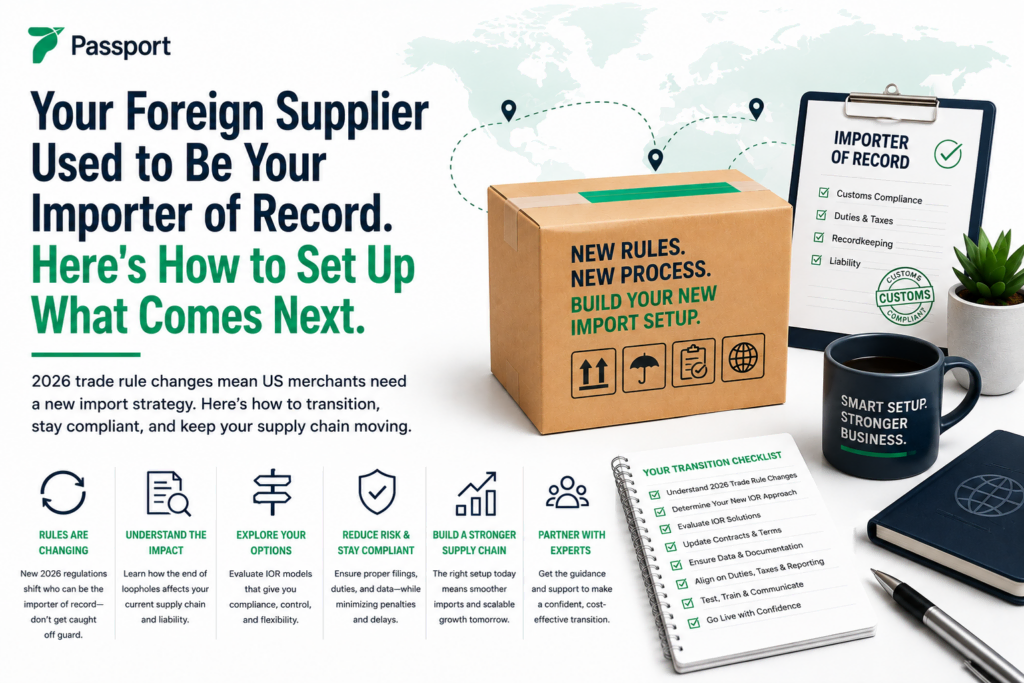
For years, many DTC brands sourcing overseas leaned on a simple workaround to get their products into the U.S.: let the foreign factory or supplier act as the Importer of Record (IOR). It kept the paperwork off the brand’s plate and let goods move under a delivered-duty-paid (DDP) arrangement without the brand ever touching a CBP form. And when tariffs escalated in 2025, many foreign suppliers offered to take on this work as IOR — our guide to foreign-supplier DDP arrangements has more on how that trend played out.)
That workaround is going away. Executive Order 14411, “Strengthening Customs Enforcement,” signed June 3, 2026, directs U.S. Customs and Border Protection (CBP) to tighten the rules on who is allowed to serve as an Importer of Record — and foreign IORs are getting hit the hardest.
If your brand has been relying on a foreign supplier, factory, or overseas entity to import on your behalf, this is the moment to check whether that arrangement will still work.
What Executive Order 14411 actually changes
Executive Order 14411 gives the Department of Homeland Security and CBP 180 days, until November 30, 2026, to rewrite importer eligibility rules. The order draws a sharper line between U.S. and foreign IORs, and the changes headed for foreign IORs include:
- Informal entry goes away for foreign IORs. Consolidations valued below $2,500 that used to clear as “Type 11” informal entries will no longer be eligible if the IOR is a foreign entity.
- Tighter bonding and asset requirements. All IORs will face minimum bond coverage or tangible U.S. asset requirements, but foreign IORs face additional restrictions — including limits on using a continuous entry bond unless CBP is satisfied that revenue is protected.
- CTPAT gets tied to eligibility. Foreign IORs that want to keep filing formal entries will generally need to be CTPAT-validated themselves, or route filings through a CTPAT-validated customs broker.
- A “good standing” requirement. CBP will define good standing based on an IOR’s (and its affiliates’) compliance history and payment of duties. Fall out of good standing, and importing stops.
- More disclosure. Anticipated import volumes, ownership, beneficial ownership, and business affiliations all become reportable.
- A stricter test for who counts as a U.S. IOR. Setting up a U.S. company won’t be enough on its own. Under Section 10 of EO 14411, an entity counts as a U.S. IOR only if it is organized under U.S. law, is located in the United States, and has controlling beneficial owners who are U.S. citizens or lawful permanent residents. An entity that owns a significant amount of U.S. real property can also qualify, as determined by DHS. The order says “located in the United States” means, at a minimum, a principal place of business in the U.S., a physical presence where significant business activity takes place, and enough tangible U.S. assets for the size of the operation, including whether the entity is simply an arm of a foreign manufacturer without a substantial U.S. presence. DHS still has to issue guidance on what “located in the United States” means, and the order tells it to focus that guidance on stopping shell companies, sham transactions, and artificial corporate structures. A U.S. LLC with an EIN, a registered agent, and a mailing address may not pass.
CBP has been pretty direct about why: undervaluation, misclassification, and shell-company arrangements are named as exactly the problems this order is meant to close off.
A foreign supplier acting as IOR for a brand it ships to is the kind of setup CBP is looking to unwind.
As of mid-October, the core foreign-IOR rules (eligibility, bonding, good standing, risk-based tiering and vetting) have not been published yet. Expect them close to the November 30 deadline, and we’ll update this post when they land.
Form 5106 enforcement is live: check your IOR data now
CBP didn’t wait for the full rulemaking to start acting. On August 19, 2026, it published a Federal Register notice announcing “initial steps” to implement EO 14411, focused on the accuracy of CBP Form 5106 (the Importer Identity Form), which every IOR has on file with CBP, usually submitted through their customs broker.
Since September 18, 2026, CBP has been voiding IOR numbers where the Form 5106 information is incomplete or inaccurate. A voided number can’t be used for anything, including entering goods. This applies to new and existing IORs, U.S. and foreign alike.
Here’s what CBP is actually checking, and it’s worth reading closely because it’s more specific than “keep your paperwork current”:
- Physical address. It has to be the real operating location of the Importer of Record — not a P.O. box, a freight forwarder’s address, a customs broker’s address, or a registered agent’s address.
- Direct contact info. The phone number and email on file need to be valid and belong directly to the Importer of Record, not to a third party filing on their behalf.
- Tax identifiers. The EIN, SSN, or CBP-assigned number has to match official records exactly.
- Power of attorney. CBP has said a customs broker’s POA must be executed directly with the Importer of Record, not through a freight forwarder or other third party. That matters for supplier-arranged DDP setups, where the broker relationship often runs through someone other than the IOR.
The notice is blunt about the stakes: inaccurate or incomplete Form 5106 data can mean immediate voiding of the IOR number, whether that number belongs to a U.S. or foreign entity — and that can mean fines, shipment holds, and legal liability on top of the entry just getting stopped at the border. CBP said enhanced enforcement begins 30 days after publication. If your IOR number does get voided, you can reach CBP at IORProgram@cbp.dhs.gov, but reestablishing a voided number is a process — not something you want to be sorting out mid-peak-season.
There’s a second, separate control to know about. Since July 16, 2026, ACE has flagged any IOR number that hasn’t been used to file an entry in 366 days as “Inactive for Entry Purposes.” International Trade Today reported on October 1, citing records obtained through FOIA, that CBP deactivated about 5.3 million IOR numbers for inactivity between June 30 and September 10, and only 599 had been reactivated by September 10. If you import seasonally or are reviving an old IOR number as a fallback, check its status before you need it.
The good news: this part is fully within your control. Two quick things fix most of the risk here —
- Check the ACE portal. Log into your Automated Commercial Environment (ACE) account and review your active filings. If you haven’t set one up yet, here’s how to get a CBP ACE account.
- Loop in your broker. Coordinate with your licensed customs broker to submit an updated Form 5106 if anything’s outdated.
That’s a real opportunity to get ahead of the fuller rulemaking that’s still coming — the accuracy check is live today, so it’s worth handling now rather than waiting.
CBP has proposed new rules for low-value shipments
On October 8, 2026, CBP published a proposed rule on low-value shipments (docket USCBP-2026-0298). It’s a separate rulemaking from the foreign-IOR rules, but it changes informal entry for every importer, U.S. or foreign. If your fallback plan is to move to a U.S. IOR and keep clearing shipments as Type 11 entries, these are the requirements you would be planning around:
- File before arrival. Type 11 entries would have to be filed electronically on or before the date of importation, instead of within 15 days after arrival.
- A bond for every informal entry. All Type 11 and Type 13 (informal mail) entries would need a basic importation and entry bond, either single-transaction or continuous.
- Higher minimum penalties. Liquidated damages for a bond breach on an informal entry would have a $1,000 minimum, or the value of the goods if higher.
- Final deliver-to party. Type 11 entries would have to identify the final recipient and address when that’s different from the ultimate consignee.
- Blanket formal entry. CBP could require formal entry for all shipments from a specific importer of record, manufacturer, or seller, or for a category of goods, not just case by case.
- Brokers as IOR for non-owners. A consignee that isn’t the owner or purchaser (a forwarder or carrier, for example) would have to appoint a licensed customs broker to act as IOR for shipments of $2,500 or less.
- Some good news for tariffed goods. The proposal removes the $250 cap on informal entry for goods subject to Chapter 99 duties such as Section 232, so those shipments could use informal entry up to $2,500.
Nothing in the proposal is in effect yet. Comments are due December 7, 2026, and CBP’s cost analysis assumes the rule would take effect in 2027. It’s still worth modeling against your own shipments now, especially pre-arrival filing, which means getting commercial data from your supplier before goods ship.
More disclosure is coming
On September 2, 2026, CBP also published an advance notice of proposed rulemaking, “Heightened Import Disclosures for Supply Chain Visibility.” It asks for comments on requiring importers to submit the export documentation their supplier filed with the foreign customs authority, expanding CTPAT requirements, and using technology for supply chain tracing. One of CBP’s questions is how much lead time IORs need to get export documents from foreign suppliers. Comments are due December 1, 2026. For brands sourcing overseas, the practical point is that your supplier’s paperwork may soon need to match yours.
What this means for brands running a foreign-supplier IOR model
This isn’t hypothetical anymore. In fact, many foreign suppliers are already notifying their U.S. merchants that they can no longer serve as the IOR. If your import model depends on a foreign supplier being your IOR, here’s what’s worth getting ahead of:
- The entry type you rely on may disappear. If your shipments have been clearing as informal entries under a foreign IOR, that path is closing.
- Your supplier’s IOR number could be voided if the Form 5106 information on file is inaccurate or stale — even if the inaccuracy has nothing to do with your specific shipments.
- Your supplier may not qualify going forward. Between bonding requirements, CTPAT validation, and good-standing rules, plenty of foreign entities currently acting as IOR won’t meet the new bar.
- You may not find out until goods are stuck at the border. IOR eligibility issues tend to surface at the worst possible time — mid-entry, mid-peak-season, with inventory already in transit.
None of this means you need to change course overnight. It just means this is a good moment to actually verify the arrangement instead of assuming it still holds — and to have a plan ready if it doesn’t.
Your next steps
- Get direct visibility into your own import data. Don’t rely solely on your broker’s or supplier’s word that everything is in order. A CBP ACE account gives you direct access to entry history, duty payments, and liquidation status. If you haven’t set one up, we covered the step-by-step process here: How to Get a CBP ACE Account.
- Confirm who is actually listed as your Importer of Record — and verify their Form 5106 is accurate and current. If a foreign supplier is your IOR, ask directly: is their Form 5106 up to date? Will they still be able to import for you in a week? A month?
- Stress-test the arrangement against the new eligibility rules. Bonding requirements, asset thresholds, and good-standing status are all moving targets right now. A supplier that qualified as IOR last year may not clear the bar CBP is building over the next several months. Worth noting: CBP’s own guidance says continuous bonds typically take one to two weeks to process, but many sureties are currently overwhelmed with requests, and it’s taking noticeably longer than that to get a continuous bond approved right now. Naturally, sureties are taking a more cautious approach and increasing diligence. If your fallback plan depends on securing a new bond, build in extra runway rather than counting on a quick turnaround.
- Have a fallback plan ready. For many brands, the practical path forward is becoming the Importer of Record themselves, or working with a U.S.-based partner that can take on that role — rather than waiting to find out mid-shipment that the current arrangement no longer works.
How Passport can help
- We can support Importer of Record solutions. Instead of routing entries through a foreign supplier that may not be the right party to serve as IOR, Passport can evaluate whether an IOR solution is available for qualifying brands as part of our In-Country Enablement service offering. • We file entries directly into ACE. As a permitted customs broker with a national permit, Passport can file formal and informal entries, manage Post Summary Corrections, and represent IORs directly with CBP.
- We help you get the fundamentals right. Product classification under the HTSUS, customs valuation strategy, origin declarations for trade preference programs, and Partner Government Agency requirements — including FDA, CPSC, and EPA considerations — all factor into whether an import program is compliant.
- We can tell you where you stand today. If you’re not sure whether your current IOR arrangement, entry type, or Form 5106 information supports your import model, our compliance team can review your setup and identify potential exposure before it becomes an enforcement issue.
If your brand relies on a foreign supplier as IOR and you want a second set of eyes on the arrangement, talk to our compliance team.

Authored by Thomas Taggart
Head of Global Trade | Passport
Thomas Taggart is a cross-border commerce leader with more than 20 years of experience in international shipping and regulatory affairs. As the Head of Global Trade, Thomas helps ecommerce brands go global by simplifying international trade, tax, and product compliance issues. Prior to Passport, he brought international shipping solutions to market through multiple roles in UPS’s product development organization.
Frequently Asked Questions
Is my foreign-supplier IOR arrangement illegal now?
Not automatically. EO 14411 gives CBP until November 30, 2026 to finalize new importer eligibility rules, and as of mid-October those rules haven’t been published. But Form 5106 enforcement has been live since September 18, and the direction for foreign IORs is set: tighter bonding, no informal entry, CTPAT requirements, and good-standing checks. An arrangement that works today can stop qualifying with little warning.
What is Form 5106, and why does it matter so much right now?
It’s the Importer Identity Form every IOR has on file with CBP, covering importer name, EIN/SSN/CBP-assigned number, address, phone, and email. Since September 18, 2026, CBP has been voiding IOR numbers when this information is inaccurate or incomplete, and a voided number can’t be used to enter goods.
My IOR number hasn’t been used in a while. Is it still active?
Maybe not. Since July 16, 2026, ACE marks any IOR number with no entries in 366 days as “Inactive for Entry Purposes,” and millions of numbers have been deactivated this way. Check its status in ACE before you rely on it, and work with your broker on reactivation if needed.
We use a DDP model with our supplier as IOR. Does that go away?
Not necessarily, but it needs to be checked. DDP itself isn’t banned. What’s changing is who is eligible to be the IOR and under what conditions. If your supplier is a foreign entity relying on informal entry, low bonding, an out-of-date Form 5106, or a broker POA that runs through a third party, that setup is at risk even if the broader DDP relationship continues.
If we switch to a U.S. IOR, can we keep using informal entry?
Yes, for now. Under CBP’s October 8 proposal, though, informal entries would need a bond, would have to be filed on or before arrival, and could be moved to formal entry on a blanket basis by importer, manufacturer, seller, or product category. The proposal isn’t final, and comments are due December 7, 2026, but it’s worth planning for.
Why is it taking so long to get a continuous bond from our surety right now?
CBP’s own guidance puts continuous bond processing at one to two weeks, but several factors are stretching that out: high volumes in CBP’s review queue (manual validation on new importer accounts or riders can add another 10 to 15 business days), extra underwriting scrutiny for newer companies or shifting import volumes, complications when an existing bond needs to be replaced or resized, and small data mismatches, like an EIN, legal name, or IOR detail that doesn’t match exactly, that stall the filing until corrected. If a new bond is part of your fallback plan, start early and make sure your paperwork matches CBP’s records exactly before submitting.
What’s the fastest way to check if we’re exposed?
Two things: get an ACE account so you can see your own entry history and confirm the IOR number tied to your shipments is active, and ask your broker or supplier directly whether their Form 5106 is current, whether the POA is signed directly with the IOR, and whether they’re CTPAT-validated (or filing through a broker who is).
Should we just become our own Importer of Record?
For some brands, yes. It removes the dependency on a third party’s eligibility status entirely. First check whether your company would count as a U.S. IOR under the new rules. Having a U.S. entity isn’t enough on its own. It needs to be located in the United States, with a principal place of business here, a real physical presence, and enough U.S. assets for its size. Its controlling beneficial owners also need to be U.S. citizens or lawful permanent residents. A foreign-owned brand with a thin U.S. entity may still be treated as a foreign IOR and face the same bonding, CTPAT, and informal-entry restrictions as an overseas supplier.For others, working with a U.S.-based IOR service (like Passport) is a faster path that avoids taking on the bonding, compliance, and filing responsibilities in-house. The right answer depends on volume, structure, and how much operational control you want.
Where can we ask CBP directly about a voided or at-risk IOR number?
CBP has set up IORProgram@cbp.dhs.gov for questions about this enforcement effort and requests to reestablish a voided IOR number. Use the subject line “Enforcing IOR Accuracy.”
Official references
- CBP: Strengthening Customs Enforcement
- The White House: Executive Order 14411 — Strengthening Customs Enforcement
- CBP Federal Register notice on CBP Form 5106 accuracy: public-inspection.federalregister.gov/2026-16911.pdf
- NCBFAA member notice: CBP Provides Notice on Accuracy of Importer of Record Data Submissions
- Related: How to Get a CBP ACE Account
- CBP: Strengthening Customs Enforcement
- Federal Register: Accuracy of Importer of Record Data Submitted to CBP (August 19, 2026)
- Federal Register: Low-Value Shipments, proposed rule (October 8, 2026; comments due December 7, 2026)
- CBP advance notice of proposed rulemaking: Heightened Import Disclosures for Supply Chain Visibility (September 2, 2026; comments due December 1, 2026)
- CSMS No. 69241265: “Inactive for Entry Purposes” status for IOR numbers in ACE
- Related: How to Get a CBP ACE Account